Home Blog Page 355

[Infographic] The Hidden Benefits Of Part-Time Work

2

Here’s an interesting fact about the US job market – fully 97% of new jobs created in 2012 were part-time or freelance positions. More people are turning to freelance work as stable, permanent jobs dry up, or simply decide to turn to a more flexible working arrangement to suit their evolving lifestyles. This number is likely to grow over the next few years as the trend of remote, freelance and casual work takes off across the world, with the rise of online freelance staffing sites and adoption of mobility tools.

This isn’t necessarily a bad thing. Part-time work can allow incredible flexibility, potentially giving you up to an additional 10 hours of extra time a week to do what you want. Here’s an infographic that shows you some of the benefits of part-time work you may not have realized:

The Hidden Benefits of Part-Time Work

[Infographic credit: DegreeQuery.com]

How To Properly Plan For Technology Projects

2

by Julie May, CEO of bytes of knowledge (b:ok)

Too often, IT firms focus on creating a solution before understanding the problem. Without a clear understanding of the business challenge and who will be served and why, it’s nearly impossible for an IT firm to give you an honest idea of the risks or unintended consequences that may occur, and any proposed schedule, budget or resulting work will start off on the wrong foot.

On the other hand, you will also find that many IT firms believe it’s possible to plan every detail in advance. This “I can see the future” method of project planning leaves very little room for adjustment and typically results in rigid specifications that cost too much to develop, while also failing to reduce project uncertainty.Finding the right balance between planning too little and too much can be difficult.

To start your next technology project off on the right foot, here’s a five-point checklist for proper planning:

Focus on the “why” before tackling the “how.”

Make sure you and your IT firm share a clear understanding of the business problem you want technology to solve.

Acknowledge that you can’t see every possible detail in advance, and plan for contingencies

Know that it is a natural course of events for your business plan, and therefore your requirements, to evolve. You must be flexible in the face of the unexpected, and know you can continue to refine details along the way.

Check that the firm has business and technical experience in your industry.

Their experience doesn’t have to mirror your proposed project, but the firm should be able to demonstrate how their experience will help them provide you with an effective solution to your problem.

Look at similar work the firm has done for previous clients and ask specific questions.

It’s not necessary that they have worked on exactly the same project before, but they should be able to demonstrate how their experience will help them solve your business problem. This insight will allow you to better prepare for the expected budget and timeline.

Ask for references from the clients for whom the firm has done similar work.

You should ask for at least three references from clients for whom the firm has done similar work. Be sure to ask the references if the IT firm solved the problem they were asked to solve or if they wandered off track. Did they provide value to, refine, and contribute to your business strategy and technical model? Also ask how well they managed meeting deadlines and budgets.


Julie May is CEO of bytes of knowledge (b:ok), which she founded in 1995 with her husband, Charles. Together they have built b:ok into one of Nashville’s leading technology companies, providing digital media development and comprehensive IT services. This is Julie’s first of four guest columns on how why technology projects run over budget and past deadline and what you can do about it. Visit bytes of knowledge online at www.bytesofknowledge.com.


Eleven Essential Components Of A Successful Social Media Strategy

5

by Neal Schaffer, author of “Maximize Your Social: A One-Stop Guide to Building a Social Media Strategy for Marketing and Business Success

Many company leaders understand that in order to survive in today’s business world, their companies must have a social media presence. But to the detriment of many organizations, strategy is lagging (way) behind. In fact, a 2013 survey showed that creating a social media strategy is still a major concern of 83 percent of marketers.

And when no strategy is present, here’s what happens: Individuals from different departments tweet at will, using the company’s official handle. Some of these 140-character messages are loaded down with cumbersome language from the company’s Web copy guidelines; others are peppered with abbreviations like “u,” “r,” and “2.” On Facebook, users who “like” the company’s page find that their newsfeeds are bombarded with promotions, surveys, and so called “news.” Meanwhile, clients are posting positive and negative feedback on both sites. Sometimes these comments receive responses; sometimes they don’t. (And that’s not even taking into account LinkedIn, Pinterest, the company’s blog, and more!)

In using such a scattershot approach to social media, these organizations are missing out on major opportunities to engage with potential and current customers, manage their reputations, and more — and they may be alienating social media users in the process. Without a social media strategy, how do you know what you’re trying to achieve, what you should be doing, how well you’re doing, what you should be measuring, and what the ROI of your social media program is?

If your company is going to enter the social media world, you need a strategy because it standardizes messaging, determines how resources are used, defines which tactics you will and won’t pursue, serves as a road map, and will still carry on its purpose through personnel changes. When formulating a strategy, be sure to look at the implications it will have on all of your internal stakeholders and include them in the planning.

Here are eleven essential components of a comprehensive social media strategy:

1. Branding: Be consistent across all channels.

Most businesses already have brand guidelines (including naming, color scheme, and imagery), and these should be applied to your social media properties as well. After all, branding is all about consistency, right? The challenge, though, is that most branding guidelines don’t include any guidance for the most important part of your brand in social media conversations: your voice.

Although your brand guidelines might make mention of tone and vocabulary for use in Web copy, social media will challenge those guidelines when you need to have a conversation with an average person. In most instances it’s okay to be less formal on social media channels  —just make sure that your updates, statuses, comments, etc. ‘speak’ with a unified voice. In the planning process, be sure to ask who represents the voice of your company in your social media branding guidelines.

2. Content: Engage in conversation.

Although cynics might dub it a mindless vacuum, social media is really about the convergence of communication and information. That being the case, what you share and talk about with social media users is important. Content provides the medium to help you engage in conversation — and creating content that is truly resourceful and shareable can have many long-term benefits to your company’s social media presence.

Keep in mind that content isn’t just about blog posts, photos, and videos. Think outside of the box! Presentations, infographics, memes, and even discussions (such as in a LinkedIn Group) are all types of content that should be considered for your social media strategy!

3. Curation: Share meaningful content.

If you’re just talking about yourself in social media, no one wants to listen (much like regular conversation!). It’s only when you begin to curate content that is of interest to your followers and promote it, together with your own content, that your social media accounts begin to breathe new life.

If you work in a business-to-business (B2B) company, this will often come down to content that you might already be sharing with your current and prospective clients on sales calls, in newsletters, or during informative webinars. If you work for a company that sells directly to consumers, it might mean sharing more photos and videos of who is using your product, stories about your brand that have never been publicly discussed, or resourceful information to nudge people into realizing they need your product.

And don’t forget that crowdsourcing content is also a great way of curating — especially if it is from your own fans’ tweets about and photos of your products!

4. Channels: Join the right networks for your company.

There are currently more than 50 social networks with more than 10 million members. You can’t — and shouldn’t — have a presence on every single one of them. Deciding which social networks to engage in, and creating internal best practices and tactical plans for each of these networks, will form a sizable part of your social media strategy.

While most companies concentrate on the more established social networks, depending on your industry, the new emerging social networks of Google+, Pinterest, and Instagram might be equally important.

5. Frequency: Post strategically, not constantly.

No two social networks are alike, and with limited resources, you’ll need to decide how much time you are going to spend on each platform, as well as what you’ll be doing there. (This will help you to maximize your ROI for time and resources spent.) It’s also important to tweak your frequency strategy for each social network from time to time so as to maximize the effectiveness of your posting.

Believe it or not, frequent posting doesn’t necessarily make your social media more effective. For instance, research shows that when a brand posts on Facebook twice a day, those posts receive only 57 percent of the likes and 78 percent of the comments per post that a single post receives.

6. Engagement: Be worthy of being followed.

Engagement should be considered in both its proactive and reactive forms. While most companies do well at proactively engaging with their own content—posting both new content and conversations, as well as the sharing of content and information from others — proactively engaging with new social media users and reactively engaging with those who comment or respond to your updates is equally important to create an effective social media presence.

Try to look at your company’s social media profiles from the perspective of an outside observer and ask yourself, Is our engagement with fans worthy of being followed? Would I follow us? And remember, engagement is a tactic to help you achieve your objective — namely, expanding your brand, attracting new customers, and growing your company — not the objective itself. But be encouraged: The odds are in your favor. Sixty percent of Facebook fans and 79 percent of Twitter followers are more likely to recommend brands that they’ve ‘liked’ or followed.

7. Listening: Interact meaningfully with customers.

It’s official: The customer service desk has gone digital. From complaints to questions to (yes!) praise, consumers (67 percent of them, in fact) are using social media to convey their thoughts, opinions, and queries. But according to Schaffer, many companies are blowing this golden opportunity. For example, a recent study showed that 71 percent of customers who complained via Twitter were not contacted by the company.

Your company needs to have a listening — and responding — strategy in place. Remember that listening means more than merely being on the lookout for complaints to defuse. Every engagement with a social media user is a golden opportunity, because it can give you real-time feedback on what your customers are thinking, liking, needing, buying, etc. You can also utilize big social data to help understand potential future trends for your products and services. And lastly, remember that a meaningful interaction with a customer—a problem resolved or a question answered, for instance — can win you the type of loyalty that money can’t buy.

8. Campaign: Regularly introduce new ways to engage customers.

Social media campaigns should not be confused with traditional campaigns that are used in marketing to promote new products or discounts. Again, in the social media world, you’re not speaking to or at customers; you’re speaking with them. That being the case, social media campaigns should leverage the social aspect of social media, combined with its viral functionality, to create events that trigger engagement from followers in a new and exciting way.

Think of it less as a promotional marketing campaign and more of an experiment to better understand — and more effectively engage with — your social media followers. Create and implement new campaigns on a regular basis (I suggest doing so monthly) around revolving themes, such as those aligned with promotional, calendar, or seasonal events. Remember to make your campaigns platform- and/or content-specific to help give you more precise data for your future planning. Surveys, quizzes, polls, product giveaways, and crowdsourcing (of photos, videos, and other content) are all good examples of campaign types.

9. Influencers: Take a cue from other users.

There’s no need to navigate the world of social media on your own. Use the examples and successes of other users called influencers to help shape your own strategy and make it more effective. Influencers can consist of individual users, companies, or media outlets that 1) are a part of or serve your target demographic audience, and 2) yield influence online through reporting, blogging, and being active on platforms such as Twitter, Google+, Facebook, and LinkedIn.

You can use website rankings, social numbers (such as the number of Facebook fans or Twitter followers), social engagement, frequency of engagement, and more to identify influencers within your target demographic group. Furthermore, websites like Klout, which scores 400 million users and analyzes 12 billion social signals each day, can provide data to help you measure influence.

At minimum, influencers provide a source for content curation, and by retweeting their content, you increase the chances that they will notice you and reciprocate the favor, thus broadening your reach in social media. Beyond merely utilizing influencers for content curation and to broaden social media reach, they should also be considered as potential collaborators in future social media campaigns.

10. Brand Ambassadors: Recruit fans to spread the word.

Brand ambassadors are current loyal customers and fans who help spread the word about your brand through their own social networks. They can also act as an advisory board during a crisis. Harnessing and rewarding ambassadors is a very effective way to help spread the word and value of your brand throughout social media because 92 percent of people trust recommendations from friends and family more than all other forms of marketing.

Whether they are current employees, alumni of your company, or loyal fans to your brand, your social media strategy should always be looking for ways to engage — and reward — brand loyalty and amplification in social media.

11. Crisis Management: Be prepared to handle trouble.

Given the speed at which information travels in social media and the fact that social media is now a primary news source for consumers and the media, it is inevitable that some sort of crisis will occur. That being the case, your company needs to always be prepared for the worst (such as an attempted takeover of social media channels by fanatics and others with an agenda). Completely integrating social media into your company’s crisis management planning is a very wise decision: 76 percent of social media crises could have been diminished or averted with the proper social media investments.

Make sure that your crisis communications plan includes messaging for each of the social media channels you’ll be investing in. Beyond that, make sure that your employees are proficient at (or better yet, expert users of) the social media tools your organization utilizes so that they won’t inadvertently make a crisis worse. Secondly, you should try to proactively build a community of goodwill with followers of your brand. Over time, your word will become more trusted, and more brand advocates will be born; both of which will help lessen the potential negative effects of any crisis.

This list primarily looks at the elements of creating a robust social media strategy from a marketing perspective, but some of these components can be easily expanded to help other internal departments achieve their social media objectives. Regardless of your company’s social media goals, though, make sure that you address all of these concepts individually in a written document so that everyone in your company — now and in the future — understands what they are and how they are meant to work together. The clearer you are, the more productive your organization’s social media presence will be.


Neal Schaffer is the author of Maximize Your Social: A One-Stop Guide to Building a Social Media Strategy for Marketing and Business Success. Named a Forbes Top 50 Social Media Power Influencer two years in a row, Neal is the creator of Advertising Age’s Top 100 Global Marketing Blog, Windmill Networking (recently rebranded as Maximize Social Business), and a global speaker on social media who also teaches as part of Rutgers University’s Mini-MBA™ in Social Media Marketing Program.


[Sponsored] Supporting Grand Ambitions: Santander

1

Getting a bank loan to support business growth isn’t always easy, especially in the current credit market when recession is casting doom and gloom over every sector of the economy. Despite the general outlook, financial services company Santander is continuing to help quite a number of businesses – both large and small – fight the economic downturn by supporting their financial needs in this dire time, whether it’s an emergency cash infusion that provides a lifeline during a critical juncture, a structuring a cash deal that allows the purchase of infrastructure for fueling a certain stage of growth, or simply consolidating their banking needs.

But don’t take our word for it – hear directly from those companies that Santander has helped in this series of videos that highlight the different challenges faced and overcome by each individual business. You’ll learn, for example, of how financial constraints were previously restricting the growth of a childcare nursery brand, or how Santander’s support allowed the restoration of a railway hotel to its former glory:


Each video in the series is a heartfelt exposé into the soul of each individual company or organization, with the founders or CEOs baring their hearts about their challenges and why they finally turned to Santander for their financial needs. If you’re a business owner, you will certainly find many of the challenges faced by these examples extremely familiar – and can sympathize with their situations.

If you’re anything like me, when you’re done watching the entire video series you’ll go away with the feeling that there’s still hope yet for entrepreneurship in the UK.

This is a sponsored article. 

Beyond the Business Plan: “Lucky” 13 Essentials You Won’t Learn In Business School

0

by Michael Houlihan and Bonnie Harvey, authors of “The Barefoot Spirit: How Hardship, Hustle, and Heart Built a Bestseller

There are a lot of different beliefs about what it takes to be a successful entrepreneur. When you look at famous, crazy-successful entrepreneurs like Bill Gates and Oprah Winfrey, maybe you feel more discouraged than inspired. I could never do what they did, you think. Sure, I’m learning a lot in business school, but I don’t think I have the “entrepreneurship gene.”

Then again, maybe you’re the complete opposite and think to yourself, I know I can start the next Facebook or Spanx… I just need the right idea, and everything else will fall into place. Or perhaps you think it’s all about luck: My product is great, but how it will do in the market is a crapshoot. Maybe it will sell; maybe it won’t!

Whatever your thoughts are on entrepreneurship, one thing is for sure: If you’re still learning about the “real” business world from inside a classroom, there’s no denying how much you can learn from bootstrappers who have been there and done that.

The truth is, entrepreneurs can be made — you don’t have to be born with that entrepreneurial gift (in fact, most successful businesspeople weren’t). It all comes down to foundational knowledge and hard work. And if you’re open minded and willing to listen to the voice of experience, you can learn the guiding principles that play a role in building successful businesses — and have a major advantage over many of your peers.

Here are 13 foundational habits that (along with a healthy work ethic) will help you to become successful as an entrepreneur:

1. Always ask yourself, How would I like this?

When you start your own business, you’ll quickly learn that there’s no class, book, case study, or industry standard that always gives you a clear answer to One Big Question: Will this choice sustain and grow my business? However, there isa simple formula that rarely steers you wrong. Your grandmother called it “The Golden Rule.” Your mother said, “Put yourself in the other person’s shoes.” Today, ask, “How would you like it?”

It’s quite simple: Would you like to be on the receiving end of your actions? Would you work for you? Would you extend credit to you? Would you like selling to you if you were a vendor? As a consumer, would you buy from you? By putting yourself in the other person’s shoes, you’ll get an objective view of your business practices and how they might need to change in order for you to build a brand you’d be loyal to. Too often, entrepreneurs limit their success by allowing fear, greed, or the way other businesses do things to guide their decisions.

2. Pinpoint your strengths and weaknesses.

We all tend to think that we can do more than we actually can. As a result, we’re overscheduled, overtired, overstimulated, and overwhelmed. In the business world, this tendency to be “over” causes us to blow our skill sets, our capabilities, and even our products and services out of proportion. That’s why we recommend that you work with a third party who knows you very well.

One of the keys to success is understanding what you have an abundance of and what you need more of — and a trusted friend or mentor can help you make those distinctions. This person can help you determine how much time you have to commit to your venture and how much money you can safely spend, for example. He or she can also keep you honest about what you do and don’t excel at, how you handle stress, and when you need to delegate tasks and call in help. It will be harder to make false claims knowing you are being held accountable.

3. Always keep in mind why you’re in business.

Before you open your doors for the first time, get clear on your values and goals as an entrepreneur. Ask yourself questions like: Why do I want to build this business? Is it simply to create a job for myself? Is it to create a legacy, or to build brand value that I can monetize at some point? What are my beliefs on how employees and customers should be treated? What lines do I never want to cross?

Consider writing the answers to these questions down and looking back at them from time to time. The reasons behind why you want to start a business in the first place will influence how you run it day to day. It’s important to stay connected to your values and to make sure that time and momentum don’t move you too far away from them.

4. Become a leader in your own category.

There was a time before terms like “social network,” “iPhone,” and “Google it” were used. So today, we encourage entrepreneurship students to create their own terms, define their own niches, and be leaders in their own new categories. Doing so can distinguish your company and lead your product to success.

What is your new term for defining your product or service? It just might catch on. Don’t be afraid to name your own tune! And don’t let initial resistance or skepticism stop you. Believe me, Barefoot caught a lot of flak from the traditional and conservative wine industry when we began to use terms like ‘personal house wine,’ and ‘velocity price point.’ But today, those terms have caught on — and are now used throughout the industry.

5. Always OVER-deliver.

As a (probably cash-strapped) entrepreneur, at times you may be tempted to cut corners in order to save a minute, a hassle, or a buck. Don’t. Remember, most consumers look for products and services that provide good value for the price. If you want to gain your customers’ loyalty, you have to offer them exactly that — and you need to make sure that they have consistently positive experiences with your company.

When products meet or exceed customers’ expectations, they are more likely to remain loyal and recommend your brand to friends, family, and associates. At Barefoot, we always strove to overdeliver by meeting and exceeding customers’ expectations in quality, quantity, and customer service. We validated the consumer’s decision to choose our brand by publicizing all of our awards, accolades, and endorsements. And we took every opportunity to get feedback on what people liked about Barefoot, and how they thought we could make it better.

6. Know the difference between customer service and complaint resolution.

These days, most companies have anything ranging from one person to a whole department dedicated to so-called “customer service.” But in reality, many of these departments should be called “complaint resolution,” because that’s what happens: Customers express their displeasure, representatives try to resolve the problem as soon as possible (often relying on a script), then move on.

Instead of handling complaints formulaically and trying to sweep them under the rug, see customer service as a way for your company to get real and timely feedback about your goods and services from the people who are using them. Remember, for every customer who chooses to engage with you about your product or service, many more may be quietly taking their business elsewhere!

Treat each customer on an individual basis. Ask about the customer’s experience with your product and really listen to the answers. Pass helpful insights and ideas on to production and marketing. And most importantly, stand behind your product. Don’t rest until the customer has something good to say about your company.

7. Don’t treat your employees like commodities.

Rarely is employee turnover talked about in business schools — and you won’t see it as a line item on a business plan, either — but it has the potential to be one of the biggest costs for your business. When a member of your team leaves, you don’t just lose that employee; you lose her hours of training, her institutional knowledge, her relationships outside the company, and (in the case of salespeople), you can lose customers who are more loyal to your former employee than the product she represented.

It’s simple: How you treat your employees directly correlates to how successful your business will be. If you treat them like a commodity—if you’re stingy with pay, recognition, and benefits — they’ll do only the bare minimum to keep their jobs, and eventually, they’ll leave.

Never forget that people work primarily for income, recognition, personal time, and security. When Barefoot began paying for performance (monetarily, as well as with days off, publicly recognizing employee achievements, and more) rather than attendance, we found our best people didn’t leave because they benefited from their own production. Those who were less productive were paid less and could not afford to stay.

8. Hire people you like, then help them blossom.

In other words, don’t hire solely based on someone’s technical skill set. You can always teach that. Instead, hire people with foundational qualities you can build on: integrity, enthusiasm, a willingness to learn, a sense of humor, and a sincere interest in your business, to name a few. A good way to test this is to give job candidates a verbal run-down of the position, your company’s challenges, and your expectations for the position. Then, have the candidate send you a one-page summary on a deadline. This will tell you volumes.

You can always train good people later, after you’ve made them a part of your team. And be sure to create an environment where your trusted team members can feel free to grow, take risks, and even make mistakes. Employees who aren’t supported and who are afraid of doing something wrong will never live up to their full potentials.

Lastly, to really get the best out of your people, find out what they excel at. Then, redesign their jobs to fit those skills. Ask others to pick up the aspects of the former job that still need to be done. You might be surprised at the positive response. Don’t put the square peg in the round hole. Build a square hole.

9. Meet deadlines (and when you can’t, be the first to call).

It goes without saying that you should do everything in your power — such as work longer hours and ask for help — in order to meet deadlines to which you’ve previously agreed. But sometimes, it happens to the best of business owners: Despite your best efforts, there’s just no way the product, service, or payment will be ready on time.

When that’s the case — and especially when it is related to paying a bill—call ahead and let the other party know that you’ll be late. Explain what the holdup is, extend your sincere apologies, and explain how you’re going to make things right. If the other party has to call you, they’ll have a much more negative feeling about you and the situation. I remember during Barefoot’s early days, Bonnie and I had to tell some of our creditors that we wouldn’t be able to pay on time. And several of those creditors extended our credit on the spot. They said we were the kind of customers they wanted!

10. Respect salespeople’s time.

Dealing with salespeople isn’t high on most business owners’ lists of priorities. These owners often brush salespeople off or leave them waiting for long periods of time. They may even treat salespeople with annoyance or disrespect. Don’t make that mistake. The salespeople who call on you have much more to offer than the products and services they represent. They are a gold mine of information and are in a position to significantly help your business.

For instance, the salesperson calling on you may have special ‘pocket’ deals to help close new customers or gain larger orders, such as reduced interest rates or extended terms. Even if she can’t offer you a deal outright, she can still be your advocate for better terms with her company and give you insights on how to maneuver successfully.

And that’s not all. Salespeople can also help you to anticipate a competitor’s move, or to be prepared for a new opportunity or a change in laws or business practices. After all, it’s part of their job to stay on top of the ever-changing marketplace. Why let your competition get the latest industry information, best deals, special closeouts, and credit terms just because you treat salespeople poorly?

11. Don’t have preconceived notions about bankers.

Often, entrepreneurs think bankers don’t care about their businesses, and as a result, don’t make an effort to develop positive relationships with them. But the reality is, bankers usually aren’t unaccommodating bad guys. They’re anxious because they don’t know how you’ll behave when times are tough.

You certainly wouldn’t want to increase terms or make concessions to someone who might blindside you with the information that a payment would be late — or might not pay at all. Once you realize that bankers and creditors have fears and goals just like yours, it will be much easier for you to be friendly, transparent, and informative. And when you are, you’ll see that these professionals are more likely to help you out. The truth is, they want you to succeed because when you grow, they grow.

12. Don’t be afraid to ask for help.

Sometimes, entrepreneurs have an “I’ll do it myself or not at all” mentality. They believe that asking for help reflects badly on their capabilities, and they don’t want to seem weak. They may not want to risk proving naysayers right or appear to be a bad investment. But the truth is, unless you’re independently wealthy with a team of experienced, trusted advisors to guide you right out of the gate, you’ll need some type of help sooner or later.

In the case of all vendors and creditors, and other strategic allies, honesty regarding where you are and what you need is the best policy. Also, don’t be afraid to ask for advice, guidance, and aid from mentors and other industry professionals. When you’re starting a business with a tight budget, you literally can’t afford to make mistakes — and that means there’s no such thing as a dumb question. I’ll never forget asking one supermarket chain’s gruff wine buyer what our logo should look like. In colorful fashion, he told me exactly what to do and what to avoid. Turns out, that advice was solid gold, and I didn’t have to pay a dime for it. All I had to do was ask a question.

13. Have heart.

Heart isn’t something you can learn from a book, class, or seminar. It’s not a skill you can master. Instead, it’s something you have to find within yourself. And when you tap into this wellspring, you’ll have grasped one of the most valuable tools you can possess as an entrepreneur.

Heart is what drives you. It’s the way you look at the world around you. Heart is about your belief in your own eventual success, regardless of the odds, the naysayers, or the time it takes. It’s the tenacity that keeps you going. Heart is having a sense of humor in the face of hardship and not taking yourself too seriously. It is about being true to your core values by supporting causes that are near and dear to you. It is helping your community improve itself, thereby giving others a social reason to buy your product. Heart is what makes you feel good about what you do.

Finally, remember that it’s easy to do the right thing and act with integrity when business is good. It’s when you’re really strapped for cash, between a rock and a hard place, or facing some other major or minor crisis that you’ll be tested. And make no mistake: Customers, employees, vendors, and others will judge you by how you conduct yourself and lead your business when the going is toughest.

Here’s the good news: Whether you’re sailing stormy seas or making more progress than you ever dreamed possible, the habits encapsulated within the Barefoot Spirit will keep you on a track you can be proud of and maximize your chances of eventual success.


Michael Houlihan and Bonnie Harvey, authors of “The Barefoot Spirit: How Hardship, Hustle, and Heart Built a Bestseller“, started the Barefoot Wine brand in their laundry room in 1985, made it a nationwide bestseller, and successfully sold the brand to E&J Gallo in 2005. Starting with virtually no money and no wine industry experience, they employed innovative ideas to overcome obstacles and create new markets.

[The Philippines] Harnessing Apps To Tackle Traffic

2

Traffic in Southeast Asia’s megacities can be notoriously bad – for example, traffic in central Bangkok or Jakarta can come to an absolute standstill by 6pm. In Manila, a study by the University of the Philippines National Center for Transportation Study (UP NCTS) last year placed the average annual losses incurred due to traffic congestion in Metro Manila at over P137 billion as of 2011. The study noted that the country has lost more than P1.5 trillion since 2001 due to traffic – a massive loss in productivity.

To that effect, Philippines’ Department of Transportation and Communication’s (DOTC) recently conducted a app challenge called the Philippine Transit App Challenge that invited developers across the country to create applications in a three-month hack-at-home competition to develop an app that will ease commuting in the megacities of Cebu and Metro Manila.

It attracted 17 entries from which 10 finalists were chosen. Last week, competition finalists got to demonstrate how their apps worked and the various benefits each offered.

Trip Barker, a community-based trip planner for mass transit systems through which users can share real-time weather, traffic, and events with their community, won the Best App Award and P100,000.00 plus a nomination to the 2014 Mobile Premier Awards at the Mobile World Congress in Barcelona, Spain next February. Sakay.ph, a web- and SMS-based app that gives commuters printable transit directions for
jeepneys, buses, and trains in Metro Manila, took the Open Community Award, while the Transport Award went to Transit.com.ph for its app that provides Cebu City commuters with route-planning tools as well as a route editor for city planners and contributors. Manila Train Guide, a trip-planning app for Metro Manila’s railways, which highlights nearby places of interest, bagged the Inclusive Technology Award. Rklamo, an app that provides a tipping mechanism via SMS for PUV drivers with good behavior, received the Voter’s Choice award.

Transport Secretary Joseph Emilio Aguinaldo Abaya thanked the developers for sharing their talent in helping provide tools to the commuting public for navigating the two giant metros. “I commend all of the participants to our App Challenge, especially the finalists who are here tonight, for spending the last three months being a part of the solution to one of our country’s toughest problems,” Abaya said at the ceremony.

[Infographic] Self-Service Support For Fast-Growing Companies

1

One of the areas that extremely fast-growing startups tend to forget about as they scale is customer service – we’ve heard stories of how some founders have been forced to man customer support hotlines when their services go down, which is usually a sign of how such support is lacking.

But can also be extremely pricey to provide sufficient redundancy in customer service support, and outsourcing it (especially overseas) can sometimes be detrimental to the business. To this effect, many startups are turning to self-service support, where sufficient resources are provided to help customers resolve their own problems.

Here’s an infographic from Salesforce’s Desk.com that shows you some of the numbers around self-service support:


[Infographic credit: Desk.com]

[Singapore] SiTF Awards 2013 Celebrates New Ideas, Launches The Portal

0

The Singapore infocomm Technology Federation (SiTF) earlier this month celebrated over 40 innovative technology solutions – across various categories including the best start-up, cloud solution, digital media, e-government, and infocomm productivity – at an awards ceremony that attracted over 290 submissions in total. Running in its 5th year, the awards is a platform that allows companies an opportunity to showcase their solutions and receive professional feedback.

Nanoveu Pte Ltd – which makes EyeFly3D, a thin flexible screen protector which, when affixed to a high resolution mobile display turns a 2D device into a glasses-free 3D viewing platform – garnered the awards’ top honors, bagging not only the Judges’ Choice award, but also the top spots in the Emerging Technology and Start-up categories.

“It was a very good night for Nanoveu,” admits Alfred Chong, CEO and founder of Nanoveu. “The win is also a testament to the ingenuity and creativity of a commercial entity working with A*STAR’s Institute of Materials Research and Engineering (IMRE) and Temasek Polytechnic (TP) scientists in turning lab research into a viable consumer product.”

This year a new category for “Most Popular Mobile Apps” was unveiled. It was won by the Land Transport Authority’s MyTransport.SG app out of 20 locally developed apps up for public voting. MyTransport.SG offers a wide range of information for all modes of land transport, empowering commuters, motorists and cyclists in Singapore to make informed decisions and better plan their journey.

The SiTF also announced a new online platform called The Portal (www.theportal.sg) at the awards, which provides informative content and resources to aid companies’ to improve productivity. The Portal is a collaborative project between SiTF and the Infocomm Development Authority of Singapore.

The winners of the SiTF Awards 2013 are as follows:

Category Award Product or Application Organization URL
Cloud Solution Gold Aqayo HRBoss (formerly known as Aqayo) www.aqayo.com
Silver Express Melody Music Box (cloud streaming) Express In Music www.expressmelody.com
Bronze AIM@iCS intelligent Collaborative System Integral Solutions (Asia) Pte Ltd www.datamining.com.sg
Digital Media Silver Aquila Style Aquila Media Pte Ltd www.aquila-style.com
Bronze STProperty Singapore Press Holdings www.stproperty.sg
Bronze mio TV Go SingNet Pte Ltd www.singnet.com.sg
e-Government Gold iCollect Immigration & Checkpoints Authority www.ica.gov.sg
Silver eCitizen Infocomm Development Authority of Singapore (IDA) www.ida.gov.sg
Bronze Singapore Memory Project National Library Board, Singapore www.nlb.gov.sg
Emerging Technology Gold EyeFly3D Nanoveu Pte Ltd www.nanoveu.com
Silver Cloud based multi-platform Contextual Visual Search Visenze Pte Ltd www.visenze.com
Bronze Fusionex’s Big Data Solution Fusionex Pte Ltd www.adv-fusionex.com
General Application Gold Fusionex’s BI Centre Fusionex Pte Ltd www.adv-fusionex.com
Silver FluCard Trek 2000 International Ltd www.thumbdrive.com/trek2/
Bronze The Gladius TechArmory www.tech-armory.com/
Infocomm Productivity Gold SE CAD Structural Engineering Software Housing & Development Board www.hdb.gov.sg
Silver Regulatory Enforcement System (V3Nity-RES) V3 TeleTech Pte Ltd www.v3teletech.com
Interactive Ideas Gold Pictoguide Go!Places
Silver Smoovpay Smoovpay Pte Ltd
Bronze m3i Video monetization Platform m3i Pte Ltd
Mobile Applications Gold OnTalkTM – Secure Enterprise Communicator Treebox Solutions Pte Ltd www.treeboxsolutions.com
Silver MyTransport.SG Land Transport Authority www.lta.gov.sg
Bronze TradeHero TradeHero www.tradehero.mobi
Bronze Beconnect NCS www.ncs.com.sg
Start-up Gold EyeFly3D Nanoveu Pte Ltd www.nanoveu.com
Silver TradeHero TradeHero www.tradehero.mobi
Bronze Aquila Style Aquila Media Pte Ltd www.aquila-style.com
Primary Student Gold Minecraft Wellinton Primary School
Silver NVTPS Dengue Awareness North Vista Primary School www.northvistapri.moe.edu.sg
Bronze Improvement to the Travel Declaration System in NVTPS North Vista Primary School www.northvistapri.moe.edu.sg
Best Presenter  Likhitesh Reddy North Vista Primary School  www.northvistapri.moe.edu.sg
Secondary Student Gold OpenEducationConsortium Raffles Institution www.ri.edu.sg
Silver Project Mate Raffles Institution www.ri.edu.sg
Bronze Animus Dunman High School www.dunmanhigh.moe.edu.sg
Bronze Cloudnet Raffles Institution www.ri.edu.sg
Bronze Meetup Raffles Institution www.ri.edu.sg
Best Presenter Rishi Varman Raffles Institution www.ri.edu.sg
Tertiary Student Gold AutoNet Nanyang Technological University, School of Computer Engineering www.ntu.edu.sg/sce
Silver Jublia Match National University of Singapore www.nus.edu.sg
Bronze Switching to IPv6 with OpenFlow Technology (SWIFT) Temasek Polytechnic – School of Informatics & IT www-iit.tp.edu.sg
Best Presenter Lua Rui Ping Nanyang Technological University, School of Computer Engineering www.ntu.edu.sg/sce
Most Popular Mobile Apps Gold MyTransport.SG (iOS, Android) Land Transport Authority www.mytransport.sg
Silver Education@Zoo (iOS) Nanyang Polytechnic www.nyp.edu.sg
Bronze PropertyGuru Mobile Apps (iOS, Android) Property Guru Pte Ltd www.propertyguru.com.sg

Ten Rules Of Business For Entrepreneurial Stay-At-Home Moms

2

By Sean C. Castrina, author of “8 Unbreakable Rules For Business Start-Up Success

If you’re a stay-at-home mom, there are many good reasons why you might want to start your own small business: Maybe you want to kick in extra money to the family income. Maybe you want to flex your marketable skills, talents, or creativity. Or maybe you simply have a little extra time to fill now that your kids are older and at school during the day. However, if you’re like many women, you may be struggling to find a reason why you personally will be able to take your dreams from “concept” to “company.” I don’t know a lot about business, you may think. Would I really have enough time? What if I don’t make any money? Where do I even start?

Hopeful “mompreneurs,” relax and take a deep breath. Launching a home-based business is more doable than you may think as long as you know the right steps to take.

I believe without a doubt that a disciplined and motivated mother can start and operate a profitable business from home while raising children. It won’t happen overnight, but with planning and patience, you can lay a broad, solid foundation for long-term success as a self-employed businesswoman.

I speak with the voice of experience. A stay-at-home dad for six years, I cared for my daughter while building several businesses, including a six-figure direct mail business that operated in 23 different cities.

I made phone calls while my daughter was napping, and I did my paperwork and proposals during episodes of Barney or Mary-Kate & Ashley videos. Yes, a big purple dinosaur was my personal assistant, but it worked! Since I was my own boss, I had a lot of flexibility, and soon I had a business that ran like a well-oiled machine.

It’s easier now than ever before to launch a home-based company. Thanks to Internet-based tools, you can reach a large number of potential customers without ever leaving your house — not to mention the 24/7 access to educational tools and the ability to instantly search for answers to your questions.

If you’re ready to start your transformation from “mom” to “mompreneur,” read on for my top ten rules of business for stay-at-home moms:

1. Figure out your field.

Perhaps you already have a clearly defined vision for your business: you’d like to design, make, and sell original pottery, or you’d like to use your degree in accountancy to start your own tax service. However, it’s very possible that you’re one of many hopeful mompreneurs who isn’t sure which field to go into. In that case, I recommend starting a service business (anything from home cleaning to tutoring to adult care) for the following reasons:

• They require minimal money to start. “I’ve never started a service business with more than $10k, and many with less than $3k — including businesses that have made me millions!

• Many service businesses don’t require a prior work history or particular qualifications.

• In most cases, they can’t be outsourced or performed by computers so you’ll always have work.

• Since you can hire others to perform the actual work while you handle the key behind-the-scenes management tasks (like hiring, supervising, taking client calls, marketing, etc.), service businesses are a great source of passive income.

Entrepreneur.com has a great list of service businesses to start you thinking. Or you might also want to visit www.newbizcoach.org for more resources. Once you’ve familiarized yourself with the possibilities and identified a few that might be needed in your area, try to poll at least 50 people to see which services they would use in the next six months, and if they’d pay the price you would charge. Their answers will give you a good idea of which field you should go into.

Also, before pulling the trigger on your business, take time to research the licenses, permits, and certifications you may need for the industry you’re entering, and make sure that obtaining them won’t be prohibitive. You can usually find the information you need at your local business tax office or by contacting your Chamber of Commerce. And take it from the voice of experience: Start filling out that paperwork early. Government bureaucracies can be painfully slow!

2. Set aside a workspace.

When you’re working from home — a place that’s full of distractions ranging from laundry baskets to televisions — setting up a dedicated workspace is crucial for productivity. Depending on your home’s layout and how accessible you do or don’t need to be based on your kids’ ages, you might be able to use a spare bedroom, a basement, a detached garage, or even a nook in the living room as your “office.”

Personally, I converted our dining room into an incredible home office. I was able to do this on a dime because the room was already equipped with a large but seldom-used table. If you go this route, you might want to add a file cabinet and swap the chandelier for recessed or track lighting. (As I found out, it’s hard to tap into your entrepreneur mojo when you’re constantly ducking a chandelier!) Best of all, I was still in a central location where I could keep an eye on my daughter while I worked.

3. Create a dream board. 

While you’re still in the planning stages, set aside an hour to tap into your creative side. Envision your goals for your business: what you’ll make or sell, who your customers will be, and — most importantly — how being an entrepreneur will positively impact your family and your future. Then glue images and words that remind you of those things to a piece of cardboard or poster board, and make sure the dream board is visible in your workspace.

Dream boards may seem small, but they’re very important. On those inevitable days when you think you must be crazy for starting a business while you’re already handling the toughest job on the planet, looking at photos of the vacation destination you want to visit, the logo of the college your child will attend, or your debt-reduction schedule will motivate you and remind you why you became an entrepreneur in the first place.

4. Get real about pricing.

When you’re just starting out, you may be tempted to offer rock-bottom prices for your goods or services. After all, you don’t want to alienate potential customers by charging too much… and isn’t underselling the competition a reliable strategy? Well, maybe — but that’s not the way to make a profit. Especially when you’re just starting out, you can’t be in the business of offering mega-discounts. If you recoup only enough money to pay labor and operating costs, you may be helping to feed your employee(s)’ family, but not your own.

A good rule of thumb is to charge prices that will net you at least twice what your labor and operating costs would be. When determining pricing, estimate fewer jobs or sales than you expect to have. For example, say your monthly operating costs are $800, you need to pay an employee $15 an hour, and you expect to do a minimum of 40 one-hour jobs a month. Together, your operating and labor costs are $1,400. So in order to make $2,800 total a month (which, remember, is before taxes), you’d need to charge $70 per job.

5. Make room for a marketing budget.

One of the biggest mistakes new business owners make is not including a marketing budget in their operating costs. In a nutshell, this is the money you invest every week or month to tell your community why they need your product or service, and why your company is the one they should choose.

If you do not reach and retain customers, you won’t be in business — you’ll be bankrupt. First, figure out what makes your business unique: what it offers, why people need your product or service, and why consumers should choose your company over any other. This is called your ‘unique selling proposition.’ Use all or part of it to create taglines, logos, marketing messages, etc. that will enable you to advertise through websites, social media, newspapers, fliers, etc. Then do a little research to estimate how much these types of advertising might cost so that you can budget for them.

6. Hire smart.

If your business will need one or more employees other than yourself (this is especially likely if you’re starting a service business), be aware that how and whom you hire will affect how successful your business is. Before you even think about placing your first employment ads, get familiar with federal, state, and local labor laws (these cover areas like hiring discrimination, child labor, independent contractors, immigration law, and more). Don’t worry; you don’t need to navigate these areas on your own. If you become a member of the National Federation of Independent Business (NFIB), you’ll have free access to its labor law hotline. You can also consult with an attorney.

Once you’re familiar with all applicable hiring laws, it’s time to get the ball rolling. First, I recommend making sure that you can get the labor you need before you officially open your doors by running test ads. If you don’t get five applicants within three days, you might want to rethink which field you’re going into, because you want to run a business that is effortless to hire for. At this stage, if you like, you can hire respondents as subcontractors (not official employees) who work when you have jobs for them—after thoroughly vetting them, of course. Once your business becomes more popular, you can consider hiring your subcontractors full-time.

When you do reach the full-time hiring stage, make it your mission to look for talented, smart, experienced, and competent people with integrity. Don’t automatically hire friends and family members because it’s convenient! Remember, experience, competence, and commitment are invaluable assets.

7. Buy some online real estate.

Many would-be small business owners (especially those who plan to do all of their business locally) figure that traditional print or radio advertising will be enough to spread the word about their companies. That’s archaic thinking. Since most of your prospective customers — even those born during the heyday of newspaper and radio—are surfing the Internet, websites are no longer optional.

Developing an online presence is as essential as having a business card. At minimum, you need a homepage that functions as a business storefront, conveying your unique selling proposition, pricing, and contact information—though sections for customer testimonials, employee bios, and photos don’t hurt! Check out the competition’s websites to see what works and what doesn’t. If you can’t afford to hire a website designer, check into the growing number of DIY systems that allow you to plug your specific information into cheap built-in templates.

8. Focus on providing great service.

After your business opens its doors, it will develop a reputation. Whether it’s a good or bad one is largely up to you. To make sure that customers hold your company in high esteem, focus on providing great service to each and every customer from day one. Word of mouth is important for the growth of any business.

What ‘great service’ looks like, of course, will depend on your field. Let’s use a lawn mowing company as an example. To show that your company does the little things that big companies won’t, you decide that your employees will pick weeds out of flowerbeds for no extra charge. In this scenario, I would recommend giving each client a postcard printed with two boxes (labeled ‘lawn mowed’ and ‘flowerbeds weeded’) for each visit. At the end of the job, your employee would be required to check each box. Not only does this make sure your employee does the work — it also shows the customer how important this ‘extra’ weeding service is to you.

Another aspect of providing great service is putting quality control measures in place. In other words, make sure your customers get what they pay for. Be prepared to listen to the occasional complaint and to rectify the problem. It’s also a good idea to periodically survey customers to make sure that they’re satisfied with the goods or services you’re providing and to see if they have any ideas for how you can improve.

9. Take advantage of cost-saving opportunities.

Since you’ll be using your home as your exclusive place of work, you can save a lot of money compared to entrepreneurs who are based in a more public space. Besides enjoying obvious money-savers like not needing to pay rent on and equip an office or shop space, purchase a professional wardrobe, or spend time and money on a commute, you can — and should — be proactive about using your business’s location to reduce operating costs.

One of the main ways you can do this is to capitalize on tax deduction advantages. For example, if you set aside a separate room of your house in which to conduct your business and/or store products, you may be able to take a home office deduction. You can also write off transportation expenses to and from your home to your business appointments, and in some cases, expenses related to car maintenance and repair. Remember, lack of capital is the number one reason why businesses fail. Every dollar counts!

10. Use your time wisely.

Good time management is an important skill for any entrepreneur to have, but it’s especially crucial for stay-at-home moms, who are splitting their time between taking care of children and building a business. Wasted time has been the downfall of many mom-run businesses, because if you’re forced to choose between spending your last hour on your children or your business, caring for children must come first.

Whenever possible, I recommend planning each day the night before. Write down all of the things — family and business related — that you’d like to do the next day. Then, mark each one with an A, B, or C. As are tasks that must be done. Bs should be done, and Cs would be nice to get around to. This system will help ensure that you’re spending your time on high-value activities instead of responding reactively to every shiny ball that rolls by.

While these rules don’t cover every step of creating your own business as a stay-at-home mom, they will help you to head in the right direction. So stop procrastinating. If you have a good idea for a business or want to start earning more money, there’s no time like the present to join the ranks of successful mompreneurs.


Sean C. Castrina is the author of 8 Unbreakable Rules For Business Start-Up Success and the soon-to-be-released 8 Unbreakable Rules for Small Business Dominance. He is also founder of newbizcoach.org. A successful business coach and a true entrepreneur, he has started over 15 successful companies over the last 18 years. His companies have ranged from retail, direct mail marketing, and advertising to real estate development and home services.


[Infographic] Real Money, Virtual Wallets

1

Many of us have problems managing money, but the more conscious among us are turning to online and mobile tools to help keep our finances in order. Thankfully, a plethora of money management tools are now available to help us keep track of income, bills, loans and even credit cards.

We’ve heard of how apps like Mint.com can help folks save both time and money, and nothing is quite indicative of a good entrepreneur than one who knows how to keep a tight hold of their personal finances (which will be reflective of how they manage company finances).

Here’s an infographic that looks at some of the data surrounding the usage of web or mobile money management apps, as well as highlight some of the apps available on iOS, Android and online apps you can use to make sure you don’t (unknowingly) go down the path of bankruptcy:

Real Money, Virtual Wallets

[Infographic credit: Real Money, Virtual Wallets]

New Devices Put The Cloud At Your Fingertips

0

Long gone are the days when most files only lived on a local computer. The past several years have seen cloud-based storage come into its own in a big way. No matter what your needs, either to store and back up your own business files or to collaborate with colleagues on the other side of town (or the other side of the country), there is a cloud storage solution to suit your needs. Cloud services are not just for traditional computers anymore, either.

Here is a roundup of devices that use the cloud to provide powerful functionality that goes wherever you do:

The Smartphone in Your Pocket.

Okay, it’s probably not a surprise that a phone is a cloud-storage based gadget. You may not realize all the ways in which your phone can leverage the cloud to your advantage, however; nor the ways in which it is already doing so. If your email syncs between your laptop computer and your phone, for instance, that’s effectively an example of the cloud at work. In addition to email, myriad other apps and services allow you to access your important files anywhere you are. Some services, such as Google Drive, even let you make changes to files within your virtual data storage without ever downloading them to your phone or computer. The less you need to shuffle files around, the more efficient your work will be.

Trading Laptops for Tablets.

Depending on the nature of your work, you may be surprised at how well a powerful tablet device can meet your needs. Most tablets have very limited storage compared to what is available in laptop or desktop computers, but cloud storage quickly negates this disadvantage. In fact, researchers with iHS are finding that the average amount of storage in both tablets and smartphones is decreasing. Consumers are choosing devices with less storage, and hardware makers are offering more tablet and phone models with lower amounts of storage. Such devices are the result of the explosion in cloud-based storage and applications. There’s no need to cram your tablet with all the data it can hold when you can access a world of data, including all of your own files, via the cloud. Entrepreneurs, journalists, educators, marketers and many other professionals are discovering that a tablet and access to a virtual data room make working on the go easier than ever.

Personal Cloud Technology.

As with any innovation, there are caveats about cloud computing and cloud-based storage. Some people are concerned about the privacy of their data, and, with constant news about security breaches and alleged government spying, it’s not hard to understand why. These concerns are even more important for professionals who work with other people’s data. If your clients are entrusting you with their personal data, especially sensitive data, cloud storage may feel like the wrong answer.

Many of these concerns can be alleviated by using “personal cloud” devices. These are combination devices which provide local file storage and backup facilities, but also make files available via the Internet. They enable you to maintain the privacy and security of your data, while also having the benefits of a cloud-based storage service. These devices are network-enabled, meaning that all of the computers in your home or office can connect to them. Some of them will sync with another device at a different location, which provides the benefit of off-site backup. If you keep one device at home and sync it with one in the office, the loss of one device will not mean the loss of all your data. Finally, because these devices are personal, you can avoid the fees of using a cloud-based storage system. After the initial cost and setup of the device, it’s free to use forever.

Computers You Can Wear.

With the 2013 release of Google Glass and growing rumors about an unannounced “iWatch” from Apple, wearable computers have rocketed into the public consciousness. These and other “wearable computers” depend greatly, if not entirely, on cloud-based services. Other, more limited devices already fall into this category, such as the Fitbit and other devices which track your activity levels and other health-related data. Fitness devices don’t connect to cloud storage for access to files in the same way as a computer, phone or tablet would, but they can upload consistent data about your activity habits and some vital statistics which can assist you in pursuing your health goals. More capable devices, such as Google Glass or the Pebble Watch, enable a much wider set of features related to the cloud, such as checking email, sending messages, looking up information on the go and accessing your own files. These devices are in their early stages, but cloud-based computing and storage are making them possible in ways that were unthinkable a few years ago.

If you have not yet looked into cloud storage, it’s well worth taking the time to see what’s out there.  If you have basic cloud storage, it may be time to take a fresh look.  New devices, services and apps are bringing in a whole new world of flexible, powerful functionality.

Five Important Questions That Will Help You Avoid Bad SEO

1

Search engine optimization, the collection of strategies and tactics to improve search rankings, has built an industry based on no clear guidelines.

Major search engines such as Google and, to lesser degrees, Bing and Yahoo do not disclose the factors that affect search ranking.

This is why the industry can only provide suggestions and test tactics rather than have a set blueprint to their work. Everything, too, progresses on-the-fly due to algorithm updates, so what works today may not be effective tomorrow.

Due to these wild swings and uncertainty of definitive ranking factors we have seen a growth in low-quality services since businesses owners fail to see warning signs of bad SEO. Likewise, a company that charges a great amount of money may provide the same low-quality service disguised by the notion of premium services.

The SEO industry isn’t doom and gloom, though.

The evolving strategies and tactics have proven to be effective when they’re applied in a logical, ethical manner. It’s very easy to find great SEO companies when you do due diligence and research.

The Five Questions You Need to Ask.

First, let’s outline the questions:

1.  What is the reputation of this company?

2.  What data can they provide me to prove their work is quality?

3.  What are these services going to cost me?

4.  What tactics and strategies will be implemented?

5.  How are they going to report to my business?

Now let’s expand on them:

The reputation of a company matters when doing research. A company that has multiple reviews, testimonials, recognition from business partners, and high rankings of their own can tell you they’re reputable and get the job done. Compare reputations using a site like SEOCompanyReviews.com and carefully assess the different metrics and tactics.

A company should be willing to provide data of their work. They may not be able to disclose client specifics but if what they claim is true then they have data and reports in-house. Knowing and seeing their results in hard-copy will prove they will deliver upon their promises.

Costs are always a factor when it comes to SEO. Too low of a price should raise red flags because it means they’re likely using programs and tactics that are frowned upon. Too high of a price could mean they’re gouging. Find the right balance by comparing multiple SEO companies for a median price.

You may not completely understand them but knowing the tactics and strategies will help you avoid costly SEO mistakes. If a company fails to disclose how they will conduct SEO, back away because they could be doing black hat tactics that can harm your overall search rankings in the long-run. Ask what they offer, how they will conduct their strategies, and take the time to learn about the tactics so you can properly discuss projects.

Finally, make sure that the company can provide reports to your business. Do not let them go off on their own and contact sporadically every few months. Ask for details about current rankings for keywords, search traffic, social engagement, and what tasks they are completing. Treat their services as how you’d want an employee to report.

Conclusion.

Education is your weapon to combat bad SEO and find a company that will provide you with real results.

Take the time for due diligence, ask the right questions, read reviews, and compare all the offers before you hand over the money. Great SEO is worth paying for if you know what you’re getting yourself into.


[Singapore] Cybercrime Incidents Down In 2013, But Losses Up: Norton

1

Here’s some good and bad news for Singapore – the good news is, cybercrime incidents in the country this year as reported has dropped by almost 25%. The bad news, however, is that those who do fall to cybercrime are losing so much more than before. According to the latest 2013 Norton Report by Symantec, the number of online adults who have experienced cybercrime has decreased from 48 percent in 2012 to 37 percent this year, but the average loss per victim has skyrocketed by 75% at S$1,448 from S$826 in 2012.

While cybercrime in Singapore is generally low compared to other high-risk countries (Russia sees 85% cybercrime rate, with China at 77% and South Africa at 73%), the sharp rise in losses from cybercrime is cause for concern.

“Today’s cybercriminals are using more sophisticated attacks, such as ransomware and spear-phishing,which yield them more money per attack than ever before,” said Philip Routley, Symantec’s Product Marketing Manager for Consumer & Small Business. Ransomware refers to malicious software that restricts access to the systems it inflicts, while spearphishing are specific, directed attacks at individuals and companies aimed at acquiring sensitive and confidential information such as usernames, passwords and even credit card details.

“With 59% of consumers using their personal mobile device for both work and play, this creates entirely new security risks for enterprises as cybercriminals have the potential to access even more valuable information.”

This year’s report also shows that while consumers become more mobile and connected, these conveniences often come at a cost to them and their security. Despite the fact that 79 percent of those surveyed own smartphones and 40 percent own tablets, two-in-five don’t take basic precautions such as using passwords, having security software or backing up files on their mobile device. Worse yet, it’s not purely down to ignorance – two-fifths (44 percent) of consumers surveyed admitted that the convenience of being constantly connected outweighed any potential security risks. Even when 67 percent said that there is no such thing as “online privacy” in today’s world and 64 percent assume that “everything they put online will / can be seen by any and everyone.”

“Unfortunately while consumers are protecting their computers, there is a general lack of awareness to safeguard their smartphones and tablets. It’s as if they have alarm systems for their homes, but they’re leaving their cars unlocked with the windows wide open. This carelessness places them, and their digital identities, at risk,” he adds Routley.  

[Review] The Social Customer

0

The greatest challenge of our “social age” isn’t to grow the largest fan or follower base. Neither is it to achieve the greatest reach or “virality” in one’s digital campaign.

Rather, the challenge is this – how can we transform fans and followers on social networks into actual money paying customers?

While Facebook, Twitter and YouTube have found ways to monetise their platforms, many are still figuring out ways to connect the social web with the corporate wallet.

Enter “The Social Customer: How Brands Can Use Social CRM to Acquire, Monetize, and Retain Fans, Friends, and Followers” by Adam Metz. Covering a wide range of topics on social Customer Relationship Management (CRM), this ambitious book spans a wide spectrum of social business topics. They range from customer insights, marketing, sales, analytics, demand management, support, and customer experience, to mobile and location based services.

To understand what Social CRM is, let us first consider this definition by Metz:

The customer owns the conversation now, so companies need to change the way they do business. Social CRM is a philosophy and a business strategy that uses technology, work flow, business rules, and social information to talk with (not at) the customer in a transparent way, to make value for both parties.

In order to make their brands “social objects” (stuff which people want to talk about), companies can consider the six foundational premises of Social CRM articulated by Paul Greenberg. These state that companies should make themselves likable, help customers control their lives, help customers fulfill their agendas, and be non-obtrusive and valuable while providing memorable experiences.

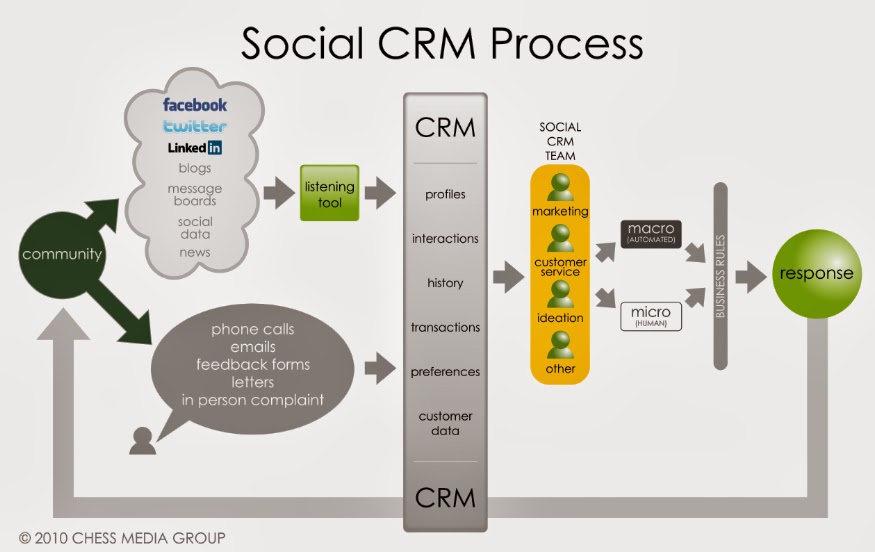
According to Metz, the Social CRM process is fairly involved. It covers community management, listening on social channels, mining of one’s customer database, establishment of a social CRM team, and the invoking of either macro responses (automated activities like birthday coupons) or micro responses (manual interventions like organising a press briefing). These activities can be visualized by Chess Media’s chart below:

Courtesy of Chess Media Group

From the basics, Metz goes on to describe the 23 Use Cases of Social CRM. Covering social customer insights, marketing, sales, service/support, innovation, collaboration, and customer experience, the use cases illustrates examples of companies doing them, market and technology maturity levels, and recommended vendors.

You can see how these concepts are categorised in the chart by Altimeter Group and Metz Consulting below:

Courtesy of The Social Concept 

From the Use Cases, the book proposes that a Social CRM methodology could be adopted. Represented by the acronym lPOSTm, the steps involved are…

l = Listening to what your customers are saying
P = People and your relationships with them
O = Objectives, ie what your brand wants to do
S = Strategy, the stuff that the book teaches
T = Tools, the myriad platforms and software needed
m = Measurement, a necessary evil

To make one’s social CRM strategy come alive, the book proposes the following key ideas:

1) Adopt a strategy canvas approach (ala Blue Ocean Strategy) to differentiate your business from the “red oceans” of competitors. Here you should consider the Four Actions Framework, namely to eliminate factors your industry take for granted, raise factors of social customer management above industry norms, reduce areas that are less valuable to social customers, and create new factors of value.

2) Avoid confusing Social CRM with its disparate components like database marketing, IT systems, loyalty programmes, social media platforms, or marketing and PR alone.

3) Create a holistic way of measuring your Social CRM activities through dashboards monitoring KPIs such as the following:

a) Net Promoter Scores (ie how likely are your customers to recommend you to others)
b) Brand Reputation (usually provided by social sentiment firms)
c) Social Collateral Engagement (ie online “buzz” like conversation levels, influence of commenters, sentiment of comments, and qualitative feedback)
d) Social Ecosystem Health (number of members, type of content, traffic, interactions, and response)
e) Social Commerce (sales, reach and group marketing efforts, often by affiliates)

4) Crafting detailed workflows and escalation paths. These necessitate the integration of Social CRM systems with Enterprise Resource Planning (ERP) and Supply Chain Management (SCM) systems to provide seamless end-to-end service to customers and partners.

5) Embracing social advertising and retail, as well as the exciting opportunities offered by mobile and geo-location technologies.

In a nutshell, “The Social Customer” provides a comprehensive guide to the exciting world of social CRM and social commerce. Unfortunately, the book does get into the problem of trying to tackle too many topics under its cover. At times, I found it difficult to visualize how the various multiple systems look like and had to stop to think hard to imagine how A connected to B and C.

Having said that, Metz does provide lots of useful links and references throughout the volume. He is also fairly generous in giving credit to many of his contemporaries while citing and modifying their ideas. As such, “The Social Customer becomes a useful springboard for one to venture more deeply into the world of Social CRM.

[New York] INGENUITY 2013

1

Despite the challenging US economy, the New York startup scene is burgeoning. And to capitalize on its meteoric challenge to Silicon Valley as the alternative location to startup up in the United States, the New York Venture Capital Association (NYVCA) will be presenting its annual INGENUITY conference on October 15, 2013.

In its fourth year, INGENUITY has become one of the key events in New York that brings together investors, founders and other players in the NYC startup scene together to celebrate and champion tech innovation as well as collaboration. In addition to pitches by some of New York’s hottest startups – culled from over 140 applicants – INGENUITY attendees will be treated to keynotes, fireside chats, and panels with industry leaders and creative thinkers including Greg Coleman, President of Criteo; David Gilboa, Co-Founder of Warby Parker; Eric Hippeau ofLerer Ventures; Emily Steel of The Financial Times; JJ Ramberg of MSNBC’s “Your Business”; Blake Irving of GoDaddy; Chantel Waterbury of chloe + isabel;and Andrew Siegel of Conde Nast.

The 16 finalists that have been selected – covering a range of industries, from mobile, digital media and healthcare to fashion, and Internet services – to pitch are:

  • Crowdtap
  • Dashlane
  • Miner
  • Partpic
  • WeDidIt
  • Zipments
  • Greatist
  • Hopscotch
  • Shake
  • Fancy Hands
  • HeTexted
  • YouBeauty
  • Little Bits
  • Precision Demand
  • AdStruck
  • Coinsetter

“The quality of the speakers is exceptional and the networking opportunities provide us with access to key influencers in the New York tech community and pre-IPO companies,” says David Ethridge, SVP & Head of Capital Markets for NYSE Euronext.

The event is expected to attract over 500 attendees, and is open to investors, entrepreneurs and members of the media for a full day of pitches, keynotes and networking. You can sign up for it here.

Forbes Announces 2013 List Of Best Small Companies In America

1

American business magazine Forbes has announced its list of “The Best Small Companies in America” for 2013, with Questcor Pharmaceuticals, Inc topping the rankings of 100 small businesses based on earnings growth, sales growth and return on equity in the past 12 months and over five years.

Those companies that were considered by Forbes were publicly traded for at least a year, generated annual revenue between $5 million and $1 billion and boasted a stock price no lower than $5 a share. Aside from the top 25, what was interesting was its list of 20 non-tech stars – that list even included beer brewer Boston Beer Company at No. 13, signalling the meteoric rise of craft beer in America in recent years.

Most of us who live outside the United States wouldn’t be too familiar with most of the names on that list; perhaps in due time we will.

[Photo: CEO John Foraker of Annie’s Natural Foods, No.10 on the list of Forbes’ “The Best Small Companies in America“; Credit: Eric Millette for Forbes]

[US] SPROCKIT 2014 Opens For Applications From Media Startups

1

SPROCKIT 2014, a year-round program by NAB Show and World Series of Start-Ups that showcases elite emerging companies in media and entertainment and introduces them to industry influencers and decision-makers, is again looking for startups to participate in the coming year’s program.

Returning to NAB Show for the second consecutive year, SPROCKIT 2014 will triple in size and accommodate up to 30 startups this time. Selected startup companies are promised to have “intimate access to top executives in media and entertainment, the opportunity to pre-schedule private meetings with industry influencers, and time to present their product or service to potential customers, partners and/or investors”. Following the NAB Show, SPROCKIT companies and select industry leaders will collaborate throughout the year in SPROCKIT Sync, an exclusive media and entertainment community focused on bringing the most innovative products, services and revenue models to market.

“After a successful inaugural year that brought dozens of innovators together, we’re delighted to host SPROCKIT again at the 2014 NAB Show,” says Gordon Smith, president and CEO, NAB. “Shining a spotlight on the leaders of tomorrow is one of the many ways NAB Show is shaping the future of media and entertainment.”

“SPROCKIT takes the most innovative, market-ready startups and provides front-and-center visibility and fosters relationships with industry icons,” adds Harry M. Glazer, founder and CEO of World Series of Start-Ups, LLC and the creator and co-producer of SPROCKIT. “This year’s program is no exception. With the new open application process, we’re giving more innovators the opportunity to change the future and join an esteemed group of SPROCKITalumni and industry-leading partners.”

“I truly believe that SPROCKIT can be a transformational hub for the industry,” says SPROCKIT 2013 alumni, Sue Fennessy, founder and CEO of Standard Media Index. “With so much clutter and noise in both the media and technology sectors, it is critical to have an unbiased central zone that can highlight and nurture businesses that will shape our future.”

To become participate, a startup company must have market validation and must prove the potential to significantly impact the media and entertainment industry. Interested companies should submit an online application by November 22, 2013 on sprockitglory.com.

WineFamily – Connecting Wine People In Asia

0

One of the key selling prepositions of e-commerce platforms is the fact they promise to bring producers and consumers together while cutting out the middle men in order to get costs down. But newly-launched Asia-based online wine marketplace WineFamily instead aims to invite licensed wine retailers across the region to create virtual stores in an Etsy-style platform and sell directly online to consumers in Asia.

WineFamily also has a social network component called Grapevine that allows wine merchants to create their own social communities, allowing consumers to communicate directly with wine makers and distributors. The site currently carries an inventory of close to SGD$3 million worth of wines available for purchase on the website – priced anywhere between SGD$19 to SGD$859 – and is first available for the Singapore market, although it will gradually roll out across other Southeast Asian markets over the next year.

Paul Gerken, Founder and CEO of WineFamily, sees the platform as a solution to the inefficient wine industry model, where wine sellers are sinking capital into websites that offer no social engagement. “WineFamily offers a solution that brings many industry players together on one wine-commerce online site, and uses that scale to increase sales for its vendors,” says Paul Gerken, founder and CEO of WineFamily. He sees the platform as a solution to what he believes is an inefficient wine industry model, where wine sellers are sinking capital into websites that offer no social engagement.

We aim to become the world’s go-to source of wine,” Gerken said. “WineFamily will enable a global dialogue among winemakers and their customers in every corner of the world.”

Concha y Toro, South America’s largest winery group, is using the platform to sell direct to its Singapore-based customers. “Concha y Toro sees the advantages of selling online directly to consumers, in particular being able to engage with our consumers in Singapore and tell more of the stories behind our wines, the winemakers and terroir, which are difficult to communicate at a retail level,” explains Guy Nussey, Regional Director for Asia, Concha y Toro.

WineFamily takes a hefty eight percent marketing fee on all wine sales, although that’s still cheaper than other platforms charging a usual 30 per cent distribution fee. But easy online access to a large portfolio of wines will likely be the key draw for consumers in Asia.

Five Ways Your Company May Be Scaring Away Innovative Ideas

0

by Mitchell Rigie and Keith Harmeyer, authors of “Smartstorming: The Game-Changing Process for Generating Bigger, Better Ideas

For most of us, the arrival of Halloween evokes childhood memories of trick-or-treating, jack-o’-lanterns, ghosts, goblins, witches, black cats—and staying up late to watch horror movies like Friday the 13th and Nightmare on Elm Street.

Although the spooky traditions of “All Hallow’s Eve” aren’t widely celebrated in the business world, those traditions can provide us with interesting metaphors and analogies for some of the challenges organizations often face when trying to generate new ideas and drive innovation.

In a world where innovation is an essential ingredient for business success, the ability to freely and consistently generate fresh, new thinking is crucial.  Ideas are the lifeblood of business. Without them, you have nothing. So it’s important to eliminate any impediments to effective idea generation swiftly and handily.

Here are five warning signs that suggest entity influences might be negatively affecting your organization’s best thinking and creative problem-solving abilities — and what to do about it.

1. Dungeon Masters are running your brainstorms.

In an ideal world, the leader of a brainstorming group is inspiring, supportive, fair, and open-minded. They encourage participation by creating a safe, supportive environment for sharing new and different types of ideas and perspectives.

Unfortunately not every leader is so skillful, or puts the best interests of his or her group first. For every well-trained and masterful Yoda-like leader, there is a Darth Vader lurking in the conference room next door. Such “dark overlords of ideation” come in many different guises: some possess dominating personalities that rule and control their groups instead of inspiring and guiding them; others demonstrate an insatiable appetite for more and more ideas, and relentlessly pressure their group to generate vast quantities without end.

We once knew a Dungeon Master who would squash creativity in every brainstorming session. At the start of the meeting, he would assert, You know how they say there’s no such thing as a bad idea? Well, that’s not true. There are bad ideas. Ideas so bad they should never be spoken out loud. … Okay, so what have we got? Needless to say, few participants had the courage to utter even one risky, unconventional, and potentially innovative idea.

2. The specter of negativity and judgment looms in air.

That’s a dumb idea! We tried something like that before — it didn’t work! The boss will fire us for even suggesting a wild idea like that! Sound familiar? That’s the sound of fledgling ideas being massacred.

Nothing will kill a group’s idea generation efforts faster than negativity and judgment creeping into the session. If participants’ contributions are repeatedly shot down, they will quickly feel self-conscious about sharing their thinking for fear of being criticized or viewed as foolish.

How much negativity is finding its way into your brainstorming sessions? It’s the role of the leader to maintain an ego-free zone. The most effective way to do that is to introduce a few ‘rules of the game’ before generating ideas.

The SmartStorming partners suggest establishing brainstorming rules such as, “Suspend all judgment,” “There’s no such thing as a bad idea,” “Go for quantity over quality,” “Shoot for wild, edgy ideas,” and “Nothing is impossible.” By having the group agree to such rules, you establish a safer, more open and supportive environment in which new and innovative ideas can emerge.

3. The session feels like a torture chamber.

The reason many brainstorming sessions feel like a veritable “house of pain” is because they are poorly planned, loosely structured, have ill-defined goals, and include few if any fresh techniques to inspire new avenues of thinking. The agony can be compounded by untrained leaders who allow group discussions to meander aimlessly, or who fail to keep the group’s creative energy high.

When enthusiasm plummets, participants’ contributions slow to a trickle. That’s when those old, familiar ideas start getting recycled over and over again.

Without big-picture planning, a sound process, active, well-trained leadership, and idea-stimulating techniques, productive sessions are virtually impossible to achieve. Efforts are expended in vain, time drags on, and participants stagger out of the session feeling like the walking dead.

4. Toxic personalities are invited.

Who you invite to your brainstorm can dramatically impact the quality and productivity of the session. Not everyone you might consider asking to attend is capable of being a team player. In fact, some may even sabotage the group’s efforts with fiendish attitudes and devilish behaviors. Here are a few of the potentially troublesome personality types Rigie and Harmeyer suggest you avoid inviting to your sessions.

Attention vampires — They always want to stand out and be the center of attention. They’ll suck the life out of the entire group.

Wet blankets — These pessimists see flaws in every idea voiced and dampen the enthusiasm level in every session they attend.

Dictators — They love every idea…as long as it’s theirs. These totalitarians believe they are the only ones with good taste. Everyone else’s contributions need to conform to theirs or risk being executed.

Obstructionists — To them, nothing is simple or easy. They overcomplicate conversations and procedures, and bring up extraneous facts or considerations that derail the flow of the group.

Ward off such evil influences! When considering whom to invite to your brainstorm, seek out individuals who possess a positive, can-do attitude and collaborative nature.

5. Carnage in the idea selection process.

How easily can your group identify and agree upon a breakthrough idea when it sees one?

Believe it or not, in many organizations, it’s not as simple and straightforward as it may seem. If a group fails to predetermine what criteria define a good idea before it’s time to evaluate those ideas, the selection process can devolve into a messy, combative contest where promising ideas live or die based on the subjective assertions of dominating personalities, or the thumbs-up/thumbs-down whims of executive privilege.

To avoid this type of mayhem, predetermine a set of selection criteria — those specific characteristics, attributes or benefits a winning idea must possess in order to successfully address the challenge at hand. Just visualize as clearly as possible what the perfect solution or end result would look like. Then consider what qualities an idea must have in order to achieve that visionary goal.

Start exorcising the demons in your innovation process.

The ability to continuously reinvent a product, service, process or value proposition is the key to thriving in an innovation-driven marketplace. The price for failing to do so is steep: you risk rapidly slipping into the twilight zone of irrelevance.

Continuous innovation demands a constant supply of fresh, new ideas. And brainstorming is the most widely used methodology for generating them. Take the necessary steps to ensure your sessions don’t turn into horror stories. Identify clear session goals; invite participants who possess a collaborative, can-do attitude; establish a few rules to eliminate negativity; select a leader who can inspire the group and create a safe, supportive environment; and predetermine a set of selection criteria to serve as a yardstick for measuring the merits of promising ideas.

By optimizing your brainstorms’ effectiveness, you will effectively eliminate any gremlins in your idea generation process and will be confident that those game-changing ideas will always be there when you need them.


A top creative professional for over 25 years, Mitchell’s Rigie expertise spans the fields of art, design, communications, strategic marketing, and human development. As a vice president and award-winning creative supervisor for advertising agencies — including Saatchi & Saatchi and Foote, Cone & Belding — and as a consultant for Grey Worldwide, he has managed creative teams in the development of campaigns for many Fortune 500 clients.

Keith Harmeyer’s professional background includes over 25 years in advertising and strategic marketing, sales and business coaching, and advanced presentation and communication skills training. As a marketing and creative executive at agencies in the Omnicom and Publicis networks, as well as founder and principal of his own marketing communications firm, Keith created countless successful brand-marketing programs and business presentations for many of the world’s best known and most successful companies.

[Infographic] What Does It Cost To Run A Startup?

0

Planning to start your own technology startup? That’s great, but do you know how much it will cost to hire the talent that would make take your idea from concept all the way to a market-ready product?

And even if you do, did you know that where you’re based also matters when it comes to doing up the numbers? It’s true – it’s cheaper to start a company in some countries compared to others. For example, it can cost almost seven times more if you base your startup in Zurich – when it comes to pay packages and office rentals – as compared to setting up shop in Manila.

While it’s true that cost is only one of the factors when it comes to choosing where to base your startup, it can be a big consideration. This infographic from Staff.com shows the great disparities in the costs of starting up – getting an office and hiring two web developers and one designer – across Zurich, Sydney, New York, San Francisco, London, Paris, Mumbai and Manila:

What Does It Cost to Run a Startup? Infographic

[ Staff.com – Connecting Great Companies with Global Talent]

[Singapore] Mobile Security Concerns Continue To Surround BYOD: SolarWinds

0

Some technology industry pundits are convinced that BYOD – or Bring Your Own Device – is a trend that will become more prevalent in workplaces as businesses adapt to changing technology trends and accept that the devices owned personally by employees can be far more advanced than those the company can provide them. But the real challenge for businesses is in the area of mobile security – BYOD can cause headaches for company IT administrators, who are usually largely unprepared to deal with various security issues that may occur from the use of personal devices in the workplace.

A recent study by IT management software provider SolarWinds actually revealed some startling facts about Singapore SMEs and mobile security, or to be more exact, the lack thereof. The survey of 150 IT decision makers at Singapore SMEs – 65 from SMEs with under 50 staff, and 85 from SMEs with over 50 staff -, across a range of industries, was conducted in September to gauge how BYOD is impacting the SME sector.

Here are some of the survey findings:

  • Almost half of those polled (47 per cent) place the security and safety of mobile devices solely in the hands of their staff, with only 16 per cent providing staff with some assistance in securing their device, such as installing anti-virus or anti-spam programs.
  • Despite the fact that over 70 per cent of respondents agreed that mobile devices pose the biggest risk to network security, and almost the same amount (67 per cent) admitted to heightened concerns because their employees used their own devices rather than company supplied devices for work, only half of all those surveyed said that they had developed an IT security plan for their business.
  • The most common issue faced by those charged with managing and securing employees’ personal mobile devices within their network was the inability to rapidly identify, quarantine and mitigate threats, with 35 per cent citing this as a problem.

The most common user behaviors on mobile devices which threaten the security of the Singapore SMEs surveyed include:

  • Loss of handsets
  • Unsecured sharing of company files/data
  • Use of unsecured WiFi
  • Creating passwords which are too easy to crack
  • Not using a VPN and visiting phishing or malware sites

Other BYOD issues included the visibility (or lack thereof) of corporate devices on the network, viral attachments, and even uncooperative employees, with 27 per cent highlighting this as a roadblock to mobile security.

“Given that more than a third of all SMEs surveyed (35 per cent) have all of their staff using their own mobile devices for work, the lack of assistance provided to staff to secure those devices poses a significant risk for organisations of this size,” says Sanjay Castelino, VP and market leader, SolarWinds. “In fact, around 10 per cent of the respondents reported that their employees’ mobile devices have already threatened the security of their organisation.”

According to SolarWinds, this figure has been surprisingly skewed upwards by larger organizations that you would have expected to have more defined security policies and procedures in place than their smaller counterparts, with 15 per cent of those in businesses of 50 or more staff reporting a previous threat to security, but just three per cent from those with less than 50 staff. Additionally, almost a third of those who had implemented a mobile security solution (31 per cent) only did so in response to a threat, rather than to mitigate against potential threats.

“These issues have been largely experienced in the enterprise or larger business end of town, but today’s results show that Singaporean SMEs are just as exposed. The survey results demonstrate a real disparity between the recognition of the potential problems posed by BYOD and the level of activity around addressing those issues,” adds Castelino. “Singapore SMEs need to take a more hands-on approach in managing their employees’ mobile devices which access their corporate network.”

Coupled with such challenges, we’re likely to see many Singapore SMEs continue to struggle with their BYOD and IT security policies in the near future.

Eight Ways To Ace An Interview

1

by Thomas Moran, CEO of Addison Group

There’s no denying that interviews are stressful, intimidating and can most likely make or break chances at landing a prospective position.

The main goal of an interview is to receive an offer, but getting to that point takes skill and knowledge. There are a lot of things to consider and prepare for before an interview, but with a little practice and training, anyone can go into an interview and leave the best impression possible.

Below are my tips for perfect interviews:

1. Arrive Early.

One of the easiest ways to make a good impression is to be on time. Be aware of the interviewer’s schedule though and do not arrive more than 10-15 minutes early.

2. Make a Lasting Impression.

The receptionist is the first person an interviewee faces, and they are often asked about the politeness and professionalism of the interviewee. Be presentable and positive from the moment you walk into the office, not just with the interviewer. In addition, remember to maintain eye contact and smile throughout the entire interview.

Along with eye contact, body language is very important. Refrain from fidgeting as it often comes across as nervous and don’t cross your arms as it can make the interviewee look closed off.

3. Know the Company.

Research the goals of the company, its current situation, history and recent events or changes. Check their social media presence and do a Google search to see if the company or any spokespeople have been in the news recently.

Going into an interview unaware of the companies past and future goals can be a turn off to the interviewer, while being knowledgeable of the company shows genuine interest in the position and company.

4. Understand the Position.

In addition to researching the company, understand what the position requires, any duties, responsibilities and expectations. Ask pertinent questions, like who the supervisor is, how and why people have failed in the past and goals for the first six months or year.

5. Be Specific.

Limit yourself from answering questions with a simple “yes” or “no.” Be specific and use examples that show accomplishments, strengths and how you’ve personally helped improve previous companies.

6. Be Positive.

One mistake interviewees make is speaking negatively of current or former employers. If the interviewer asks what you liked the least about a previous company, try to stay as positive as possible and explain how you benefited from the experience.

7. Practice.

Prepare standard interview questions beforehand so an answer is readily available. The more preparation the less likely the interviewee will be scrambling for answers during the interview. Speak slowly, clearly and with conviction.

Having a few go-to answers on the top of your mind before an interview is always helpful, and it’s important to remember to think before you speak.

8. Say Thanks.

Following up should always be a priority after an interview and sending a thank you note is a great way to express interest and thank the interviewer for their time.

While hard copy thank you notes are still often encouraged, in today’s technologically advanced world it’s acceptable to send an email as it is a faster and more direct method.


Thomas Moran is the CEO of Chicago-based staffing firm Addison Group. Addison combines a national network and localized service for broad reach with a personal touch. Specialized practices deliver the right candidate at the right time in Administration, Engineering, Finance & Accounting, Financial Services, Healthcare, and Information Technology.


Beanhunter 2.0 – Bean There, Done That

0

Coffee is important enough to many people across the world that it’s the thing that starts their day in the right way – so much so that coffee is one of the most important crops on the planet. And there are people crazy enough about their coffee that they would, err, download a mobile app so that they can find the nearest place around them that serves up their most favorite coffee blend using a specific coffee machine. Well, at least that’s according to Beanhunter,  a location-based coffee discovery app for both iOS and Android.

Coffee fanatics can search via the map search for location name, coffee brand or coffee shop. Users are able to filter results by best match, distance, equipment, brew methods and coffee brand as well as discovering the cafes where their friends are going through the activity feed. It can be used anywhere in the world and allows users to rate the coffee shops as well as add new businesses.

With more than a hundred thousand of monthly users, Beanhunter is one of the leading apps and site for discovering coffee, and particularly popular in major cities including Melbourne, Sydney, London, New York, Hong Kong and Singapore. Like most apps that rely on crowdsourcing data, depending on where you are Beanhunter may not have sufficient entries to satisfy the most demanding of customers (as some users would attest).

The app – a finalist in the 2013 Australian Mobile Awards – was recently redesigned to be optimized for iOS 7. “We’ve redesigned Beanhunter to make finding great coffee easier than before and optimized the new design for iOS 7,” says Beanhunter’s co-founder James Crawford.”We’ve completely rebuilt our iPhone app from the ground up and added a number of new and highly requested features. We wanted to make discovering great coffee a simple process and give our users more control.”

Your Inner Zentrepreneur: An Extraordinary Mix Of Power And Grace

0

By John J. Murphy, author of “Zentrepreneur

When people hear the word Zentrepreneur, several questions typically come to mind. What is a zentrepreneur? Who is a zentrepreneur? Am I a zentrepreneur? What limits us from awakening to our inner zentrepreneur? And how do we go about unleashing this extraordinary power and grace? In this article I will answer these questions.

A zentrepreneur is someone who turns good ideas into great results. We understand that we are here on earth for a meaningful purpose. We have a mission. We have a reason for being. We have gifts and we have ideas. We have talents and we have the potential to learn and apply ourselves in many ways. Our inner most essence is that of spirit, our “inspiration” to be creative and free. We are meant to explore, to grow, to learn and to express ourselves in meaningful ways. We do not have to try to do this. We simply have to recognize that it is all part of the Tao, the great current of life. A blade of grass does not have to try to grow green. It just does. A rose does not have to try to blossom. It just does. An oak tree does not have to try to grow big and strong. It is its essence. It is its purpose. Therefore, to apply ourselves in the most meaningful, productive way, we often have to get out of our own way.

Being a zentrepreneur is not so much about “who” is one. It is really more about “what” is one. People love to idolize other people, feeding on the drama and juice of the dualistic, ego thought system. We see it in business. We see it in education. We see it in politics. We see it in religion. We see it in sports. We see it in the media. Who is better? Who is the best? Who is right? Who is wrong? Right, left, good bad – resistance meets resistance.

The zentrepreneur in all of us sees past this fear-based ego-thought system. The zentrepreneur sees past the false, insecure self and recognizes that deep down we are all sacred, divine beings, frequently trapped by illusions of the programmed mind. Thus, we challenge common assumptions – about others and about the world we live in. We contemplate the wisdom of contrast, recognizing that without it we cannot know anything. What is “up” if we do not have “down?” What is ease if we do not know disease?

The contemplative mind allows us to open our minds to vast ideas and possibilities. When there is a crisis, we know there is opportunity to step up and make a positive difference. This is the perfect yin-yang balance of life, a mystical fork in the road that allows us to test ourselves. Is the glass half full or half empty? Better yet, what is in the glass? Does the quantity even matter? Perhaps a little bit of light can brighten up a whole room full of darkness. Never doubt that one enlightened person can have a major impact on millions of others.

Tapping Your True, Inner Spirit.

You are a zentrepreneur when you are applying your true, inner spirit. You are sharing your ideas and acting on them. You are finding ways to bring more joy to the world. You are part of the solution and not part of the problem. You are letting go of grief and guilt and insecurity, and you are embracing the fearless soul within you searching for expression. Spirit knows no fear so when we are “inspired” we are willing to do whatever it takes to pursue our mission. We are focused, enthusiastic and thankful for the opportunity. We are engaging and creative. We are resourceful and productive. Observers notice this “zenergy” and are inspired by it. Like energy attracts like energy. The Law of Attraction draws into our lives an abundance of power and grace to fuel our desires. Amazing things get done. Miracles happen. The world improves. The zentrepreneur takes a knee and gives thanks, recognizing that this powerful force of zenergy does not come from us – as the ego would suggest. It comes through us – when we allow it! It is always there. It is the life force. There is no shortage of this power and grace.

To “let flow” this life force, we must learn to “let go” the obstacles and barriers in the way. Many of these constraints are self-imposed. They include our fears, our doubts, our insecurities and our limiting beliefs. Most of these obstacles are subconscious, meaning we do not even know they are there. They are hidden in the mind but reflected daily in our habits and tendencies. The same is true for organizations and cultures. On the surface we see these assumptions, values, and beliefs reflected in policies, procedures and behaviors, but we often miss the underlying memes and paradigms driving the behaviors. Without healthy questioning, these flawed assumptions and misinterpretations can severely restrict us, personally, professionally and organizationally. It takes our inner zentrepreneur to change this.

Ask Thoughtful Questions.

We unleash the power and grace of the zentrepreneur by asking thoughtful questions, contemplating the answers carefully, and using discernment to act wisely on the choices we have.  As simple as this practice might seem, the answers we uncover are often quite profound. Start with a question like “What if?” What if we try this change? What if we modify our value proposition? What if we offer something new? What if we eliminate some of the non-value-added activity in the process? What if we stop doing something wasteful? What if we use our time differently? Use these questions to uncover opportunity and explore alternatives.

Be careful not to judge or criticize the ideas as they surface as this will limit the creative problem-solving process. Let the ideas flow and then sort them into options. Invite other people to help you with this exercise. Seek the wisdom and genius of a team. We do not have to know all the answers ourselves. Use questions like “Why” and “Why not?” to further explore the ideas. Use questions like “How” and “Who” and “When” to bring more discernment and practicality to the options. Prepare for the “Yeah,buts” and the “So Whats” as well. Pushback and resistance can be healthy and wise. Use it to your advantage. It is healthy to consider multiple points of view.

Keep an open mind as you search for better ways of doing things and use positive intent to hold your team together. At the end of the day we all value helpful innovation, authentic growth and genuine improvement. Zentrepreneurs get this done.


John Murphy is the founder (1988) and president of Venture Management Consultants, Inc., a firm specializing in creating lean, high performance work cultures. As a business consultant, Murphy has delivered services to dozens of organizations, including AlliedSignal (Honeywell), BMW, Chase, the CIA, Delphi, GE, GSK, Hilton, Lockheed Martin, Merck, and more. He is a LeanSixSigma Master Blackbelt.


[Portugal][Event] Explorers Festival 2013

0

Startup accelerator programs can be very tough, but none of them is quite as tough as being in a military bootcamp where you’re pushed to your physical, emotional and mental limits. Until now.

The Explorers Festival is an upcoming event in Lisbon, Portugal focused around the topics of entrepreneurship and innovation. Organized by Portuguese startup accelerator beta-i – the same people behind TEDxEdges and Sandbox Global Summit – it promises to be the largest entrepreneurship event in Portugal this year.

Explorers Festival comprises of three parts – an Explorers Bootcamp, where participating entrepreneurs are put through a grueling three-day bootcamp conducted by the Portuguese Navy Marine Corps designed to push them to their limits. The Explorers Toolbox is a series of workshops and demos over two days from startup service providers from around the world, while the Explorers Conference is a one day event that will bring mentors, professionals and entrepreneurs from all over the world to share their insights with
Portugal’s startup community.

The Explorers Festival will start with the Bootcamp (Nov 1-3) and Toolbox (Nov 6 & 7), closing
with the Explorers Conference (Nov 8). If you’re in Lisbon during that period, you may want to check it out.

[Infographic] Evolution Of The G

0

Mobile network usage has increased tremendously over the years, and mobile devices and the technology designed to carry the load has likewise evolved accordingly.

Most technology old-timers would have remembered the first cellphone we ever used, but many of us don’t quite remember how they operated on the first-generation mobile networks of the day. The old-school mobile technology of that era used analog-based protocols that could only provide basic voice services. Today that smartphone device you have in your hand pretty much works like a microcomputer, when connected to a fourth generation (4G) mobile network deploying IP-based protocols designed primarily for pushing data.

Here’s an infographic from CommScope that shows how mobile network connectivity has evolved, as well as provide numbers that forecast data consumption in the coming future:

[Review] The 5 Levels Of Leadership

0

How are peak leaders developed? What differentiates a superstar CEO like Jack Welch from other less extraordinary leaders?

The answer, according to bestselling author John C. Maxwell, lies in “The 5 Levels of Leadership“. Focused on growing one’s leadership potential in a tiered manner, the book provides pragmatic steps to scale the leadership ladder while achieving lasting impact on one’s organisation and followers.

Packed with examples from Maxwell’s own leadership journey as well as stories of legendary leaders like superstar coach John Wooden of UCLA and Southwest Airlines CEO Herb Kelleher, the book is chock full of quotable quotes and maxims. Some of the more memorable ones include the following:

“Leading an organisation is as much about soul as it is about systems…” – Herb Kelleher

“Good people are found, not changed.” – Jim Rohn

“No matter where you are in your leadership journey, never forget that what got you to where you are won’t get you to the next level.” – John Maxwell

“Victory is much more meaningful when it comes not just from one person, but from the joint achievements of many. The euphoria is lasting when all participants lead with their hearts, winning not just for themselves but for one another.” – Howard Schultz 

At its core, The 5 Levels of Leadership revolves around 5 “Ps” stacked in ascending order of significance. These are PositionPermissionProductionPeople Development, and Pinnacle. They are graphically represented by the diagram below:


Courtesy of John Maxwell

The first level of Position is achieved when one gets a job with a leadership responsibility. People often get promoted into leadership based on their potential, and a leadership position allows one to take charge of others by sheer fact of their title. People have to follow these leaders because they have the authority and right to lead them. Often, tier one leaders depend on their rank and rules to get things done.

As a leader gravitates towards a more collegial style of leadership, Permission comes into play. Here, leaders leverage on their relationships with others, relying on open communication, encouragement, trust, and effective inter-human relations to get things done.

A key thing to remember here is the Golden Rule, ie “Treat others as you want others to treat you.”

Moving up to level 3, leaders start to harness Production as a key trait. Focusing on results, such leaders demonstrate credibility by their ability to perform. Leading by example and building powerful teams, they bring clarity to their roles, generate positive momentum, prioritize activities that generate high return, and act as change agents.

At the 4th level of People Development, leaders concentrate more of their energies on training, mentoring and coaching their followers to be leaders themselves. Through reproduction, they can multiply their effectiveness. Here, leaders should recruit the best people possible, place them at the right positions, model leadership behaviours, equip others to do their jobs well, develop their life skills, empower them to succeed, and measure their effectiveness.

Finally, Pinnacle leaders at level 5 epitomise the highest leadership accomplishment, ie the ability to develop other leaders to level 4. These legendary leaders gain a lot of respect by virtue of who they are and what they represent.

Making room for others at the top, level 5 leaders focus on finding successors, work on people’s strengths, give away power, and sees the potential of other leaders. They create an inner circle to keep themselves grounded, continually develop other level 5 leaders and leave a lasting positive legacy.

Beyond the 5 levels, Maxwell also cited frequently from his earlier book “The 21 Irrefutable Laws of Leadership” (you can get a good summary of the laws here). Some of these are somewhat obvious (eg The Law of Respect where people naturally follow leaders stronger than themselves) while others are more enlightening.

Personally, I found the Law of Buy-in – people buying into the leader, then the vision – especially illuminating. From my experience, it isn’t so much HOW the vision and goal is written as to WHO backs it which matters.

While I liked the neat framework provided by the book, I felt that breaking down each level into their upsides, downsides, best behaviours, laws of leadership, beliefs and guides was a little overwrought. You do get a little lost ploughing through the hefty number of points in each section.

Overall, “The 5 Levels of Leadership” provides a useful reference to anybody keen to distil the essence of what truly effective leadership is all about. Its timeless lessons are useful in any age, and are embodied by the lives and examples of men and women who exemplify what sterling leadership was, is and will be.

Four Of The Most Influential People In Business Technology

0

by Morgan Sims

Technology is a booming industry, with Web 2.0, mobile applications, and software creating major opportunities for business leaders. Several up-and-coming business leaders emerged within just the past few years, marking the waves of change in the world of business and technology.

Here are four business technology leaders paving the way for future innovators:

1. Marissa Mayer, Yahoo! President and CEO.

Image via Flickr by Giorgio Montersino

As Yahoo! struggled to compete with search engine giant Google, the company hired former-Google spokesperson and key executive Marissa Mayer to take over the reigns as President and CEO.

Mayer earns a spot on Forbes’ 2012 list of Power Women and Time’s 100 Most Influential People in 2013. She gets tons of press coverage for ground-breaking policy changes — most notably, her decision to ban telecommuting for Yahoo! employees shortly after taking over as CEO, but instituting a generous parental leave policy for moms and dads of the company. She also is credited for overhauling Flickr, redesigning the homepage, and acquiring Tumblr and Summly. More recently, she was featured in September’s edition of Vogue, in a photo depicting “unconventional CEO in an unconventional pose,” according to Mashable, which has received a lot of attention.

2. Jeff Bezos, Amazon Innovator.

Image via Flickr by jurvetson

Jeff Bezos revolutionized the world of e-commerce with the launch of Amazon, now one of the most popular mass Internet retailers today. Bezos also earns credit for developing the concept of “predictive analytics,” which targets product listings and advertisements to shoppers based on their shopping history. Forbes names Bezos one of “The Greatest Living Business Leaders Today,” and that accreditation continues to be validated, as he now owns The Washington Post.

Amazon started out predominantly selling books, but quickly grew to tens of millions of products in a variety of categories. Today, Amazon competes with media brands for movie and digital media sales, such as e-books and digital movie downloads, which are becoming even more popular as mobile usage is on the rise.

As a groundbreaking entrepreneur, Bezos has often been described as surprisingly grounded, and extremely adept at explaining his complex, ideas, and visions for his companies. In a recent interview with ABC News, Bezos allows viewers a glimpse into his mind as he discusses what sets Amazon.com above.

3. Pete Cashmore, Mashable CEO.

By now, pretty much everyone’s heard of Mashable. What began as a simple tech blog quickly emerged as one of the leading Internet publications — impacting practically every facet of technology and business. Mashable’s Founder and CEO, Pete Cashmore, earns props from Forbes as one of “The 30 Most Influential People in Tech.”

Cashmore created what is today the prominent Internet publication on tech trends, considered a reliable source of information on technology, gadgets, social media trends and tactics, entertainment, and more. Mashable is widely recognized for The Mashable Awards, an annual program naming the top websites and applications in a variety of categories.

On a personal level, he has leveraged his platform’s popularity by raising money to build water wells in Africa, which led to the launch of the Social Good Summit; an annual conference focused on using social media to make the world a better place.

Image via Flickr by Richard Moross

4. Perry Chen, Kickstarter CEO and Co-Founder.

Technology revolutionizes the way you work and play, and reduces barriers of entry for entrepreneurs. Kickstarter is a crowd-funding application that allows anyone to create a project and ask for investments from any interested party. Perry Chen, CEO and Co-Founder, is another technology innovator earning a spot on Time’s Most Influential People list of 2013.

Despite Chen’s desire to remain a small company, Kickstarter is everywhere. From independent films to product inventors, Kickstarter is one of the most widely used crowd-sourcing platforms.  Even Whoopi Goldberg raised enough funding for creating a documentary in July 2012.

These four business technology leaders are just a few of the many innovators in the space making great strides and blurring the lines between traditional industries and the Web. Everything from the way you shop to the way you digest news changes before your eyes, thanks to leaders like these who step beyond the traditional boundaries and take risks every day.

Image via Flickr by Jason Hargrove


Morgan Sims is a writer and graduate of the University of South Florida who loves all things tech and social media. She has been involved with two startups that had their fair share of struggles, and taught her a lot about what not to do.


Five Unrealistic Expectations We Have Of “Smart” Phones And Other Devices

0

by Geoffrey Tumlin, author of “Stop Talking, Start Communicating: Counterintuitive Secrets to Success in Business and in Life

Advertisements promise that the latest smartphones, tablets, laptops, and other gadgets will put blazing speed at our fingertips, enable us to multitask like an octopus, and ensure that we never miss a thing. Because new technology promises — and does — a lot for us, it’s no surprise that we’ve fallen in love with it. But in our enthusiasm for our new digital communication tools, we’ve lost sight of the people behind the tools.

It’s time to turn that around. Our devices are great, but they can’t do quite as much as we think they can. And in fact, when it comes to communication, people can do much better.

A tech-centered view of communication encourages us to expect too much from our devices and too little from each other. Until we restore a more people-centered approach, we will continue to feel unsatisfied and largely unfulfilled by our interactions — despite having the most powerful connection and transmission devices in human history in the palms of our hands.

In truth, because of the incredible opportunities our devices offer for connecting with others, today really could begin a golden age of communication. But that will happen only if we stop romanticizing the technology and start improving our communication. We need to lower our hopes for our ‘smart’ devices and raise our expectations of each other.

Here are five unrealistic expectations that have emerged during the long honeymoon of the digital communication revolution and what we need to do to correct them:

Unrealistic expectation #1: Our new devices have made communication easier.

Just because our new devices enable us to reach out and touch someone with a few simple clicks, that doesn’t mean that communication itself has gotten any easier.

We are caught up in the excitement of the digital revolution. We’ve been lulled into believing that communication is becoming easier because technological advances make it easier to send and receive messages. But because our interactions involve quirky, emotional, and sometimes unpredictable people, we can’t eliminate imperfections from communication. Communication is fundamentally imperfect, and no matter how fancy our devices may become, they’ll never be able to eliminate the misunderstandings, the confusion, and the errors that occur when people talk.

Some communication is just plain hard. Like, when we have to communicate bad news, tackle a sensitive topic, or have a conversation to address a difficult problem. So yes, it’s easier to send and receive messages today, but it’s important to remember that communication is as hard, and may be even harder, than it ever was.

Unrealistic expectation #2: We successfully communicate each time we hit the “Send” button.

Our devices have greatly simplified the sending and receiving of messages, but there’s more to communication than that. Communication doesn’t occur until the other person understands our message, and that’s become the missing link in far too many conversations.

If you think about how we communicate today, you’ll realize that we approach the majority of our exchanges with expediency in mind. We want to plow through our inboxes, respond to new text or voice messages as soon as they come in, and get face-to-face conversations over quickly so we can move on to the next thing. The communication tasks that pile up every day make it awfully tempting to fire off quick messages or speak abruptly and think that our work is done.

But adding an extra step — considering whether or not your message is understood — can make you a much more effective communicator. The glut of messages we process on any given day encourages us to think of communication as something we do mechanically, when, in fact, communication is how we make our life. Smart communicators slow down when forming a message and consider whether or not the other person is likely to understand what they’re communicating.

Without understanding, there’s no communication.

Unrealistic expectation #3: Better communication technologies mean better communication.

Better communication technology doesn’t lead to better communication, especially when the new tools encourage speed and convenience over thoughtfulness and deliberation, and when they fragment our communication, scatter our attention, and constantly distract us from the issues at hand.

It’s ironic that tools designed to improve communication have all too often degraded it instead. My smartphone distracts me ten times more often than any ‘dumb’ phone ever did, and I got a lot more work done when the mail came only once a day. Our daily challenge is to channel the power of our communication devices without being buried by it.

Our technical capabilities have raced ahead of our actual abilities. Smarter phones don’t guarantee smarter communicators. Better communication happens only when our communication skills improve.

Unrealistic expectation #4: What I want to say is the most important part of communication.

With the promise of instant communication whenever we want it and however we want it, self-expression seems to be the king of the Internet age. But meaningful and effective communication is possible only when we consistently place our conversational goals ahead of our conversational impulses.

What separates average communicators from great ones is that the very best communicators don’t let what they want to say trump what they want to accomplish. The hardest thing in the world is to not say the witty comeback on the tip of our tongues and to restrain ourselves from saying something obviously counterproductive — but immediately gratifying — when a conversation frustrates us.

Technology has encouraged communication on our terms and led to an explosion of self-expressive, me-first messages. These same messages, unfortunately, are also the ones that torpedo our conversational goals. What you want to say is never more important than what you want to accomplish. That’s a lesson that smart communicators never forget.

Unrealistic expectation #5: Communicating to an audience doesn’t require any special consideration.

One of the greatest deceptions of the digital age is that sending a message to dozens of people is just as easy as sending a message to one person. In fact, nothing could be further from the truth.

Having a conversation with your boss is different from addressing the entire staff. A discussion with one friend is different from a discussion with 100 friends. But because all we have to do is click to send an email to all of our contacts or to post a social media message for the world to see, we’ve concluded, incorrectly, that adding people to a message doesn’t require any additional thought or consideration.

The problem with this thinking is that communication gets much more difficult as you increase the number of people. More people means more perspectives to consider. When we fail to account for these additional viewpoints, we run the risk of talking, texting, or typing right past each other, or worse, upsetting someone with a thoughtless message or a hasty reply.

It’s not practical to think through every possible perspective before posting to Facebook or sending a group email. But we should take the extra step to consider key viewpoints and ask questions like ‘What’s Uncle Billy going to think about this post?’ or ‘I wonder how this email is going to come across to the accounting department?’ Adding people complicates communication, and when we forget that lesson, conversational trouble is never far behind.

The digital communication revolution has encouraged us to expect way too much from our digital devices and far too little from each other. Our devices can’t handle anywhere near the amount of interpersonal nuance and complexity that human interaction entails. Consciously or not, we’ve quickly downshifted our expectations for our interpersonal conversations and focused too much on our devices. But the good news is that if we recalibrate our expectations, we’ll be in a much better position to take advantage of the unprecedented opportunities for meaningful connection during the digital age.

We’ve never had so many ways to reach out and connect with each other. If we put people back at the center of our conversations, this really could be the golden age of communication.


Geoffrey Tumlin is the author of ”Stop Talking, Start Communicating: Counterintuitive Secrets to Success in Business and in Life“. He is the founder and CEO of Mouthpeace Consulting LLC, a communication consulting company; president of On-Demand Leadership, a leadership development company; and founder and board chair of Critical Skills Nonprofit, a 501(c)(3) public charity dedicated to providing communication and leadership skills training to chronically underserved populations.


[Singapore][Event] AppHACK Singapore 2013 by AngelHack

0

The Singapore chapter of AngelHack – the largest global startup competition and series of hackathons in the world – will be organizing AppHack Singapore 2013, which looks to gather over 150 Singapore-based software developers and entrepreneurs together where they will create great mobile applications over the span of just 24 hours.

To be held at the offices of Microsoft Singapore on 23-24 November, AngelHack Singapore aims to get various judges from Silicon Valley to judge the competition, where the overall winner of AppHack Singapore 2013 will get accepted into AngelHack’s global pre-accelerator program, HACKcelerator. In the program, top hackathon teams get support to turn their hacks into market-ready products.

Recent Articles